The body as performance, part 3 of 6 · 10 min
Meaningless muscles: Are you training for your body, or for capital?
By Steven Wensley, MA in history, and poet.
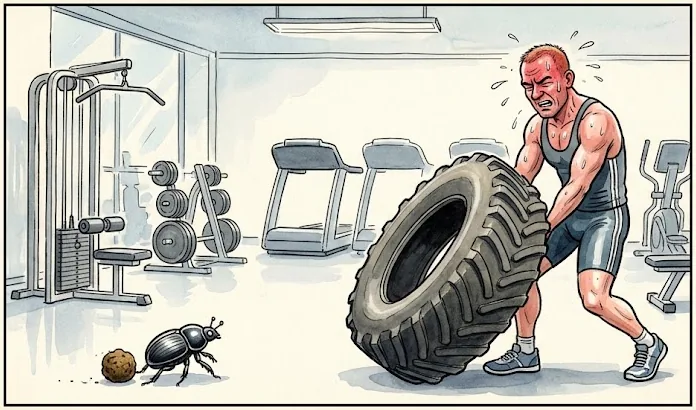
You have closed your eyes, and for one brief, agonising second you appear to be at death’s door from sheer self-inflicted suffering. At precisely that moment your smartwatch buzzes stubbornly against your wrist. The screen lights up with a cheerful little digital fanfare and rewards your near-death experience with a shower of virtual confetti for having finally "closed your activity rings". Down on the floor, just in front of your expensive, shock-absorbing CrossFit shoes, walks a small, ordinary scarab – a dung beetle. Effortlessly and stoically it rolls its perfect little ball of shit across the floor, looking up at you with incomprehension and appraisal.
For the difference between the two of you is stark, absurd and deeply comic: the dung beetle’s relentless toil serves a practical, natural, life-sustaining purpose. You are moving that gigantic tractor tyre from point A to point B solely to build up enough symbolic capital to attract a mate from a better postcode, or to display an enviable, masochistic discipline to your boss on Monday. We no longer suffer to survive; we suffer to impress.
Moving, feeling your muscles work in symbiosis, running yourself utterly out of breath and knowing what your body can do are, in their purest form, among the most connecting, spiritual and life-affirming things we can do as biological human beings. Our bodies are made for movement. They are designed by evolution to stretch, carry heavy loads, run fast and feel the physical world right down to the marrow. But in modern, digitised society something has fundamentally slipped in our relationship with the physical shell.
We have taken the pure joy of natural movement, drained it of all practical purpose, locked it away in sterile underground gyms, fitted it with an expensive monthly subscription and turned it into a cynical shop window. For very few of us is training still primarily about health, about nourishing the body or celebrating what it is biologically capable of. It has mutated into something about power, status and a narcissistic need to flaunt our invulnerability in a society suffering from a chronic, gaping deficit of meaning.
Sweat on the spreadsheet: The corporate world’s fetishisation of extreme sport
Nowhere is this instrumentalisation of the body more grotesquely plain than in modern corporate life, where gruelling extreme sport has increasingly replaced golf as the ultimate masculine executive discipline. Today it is the rule rather than the exception that ambitious chief executives, lawyers and consultants get up at 4.15 in the morning to cycle a hundred kilometres on a carbon-fibre bike, swim in ice-cold, black harbour water and run an effortless half-marathon before turning up to a board meeting at nine. All of it is meticulously logged in the Strava app, so that the network can toss virtual 'kudos' at the performance.
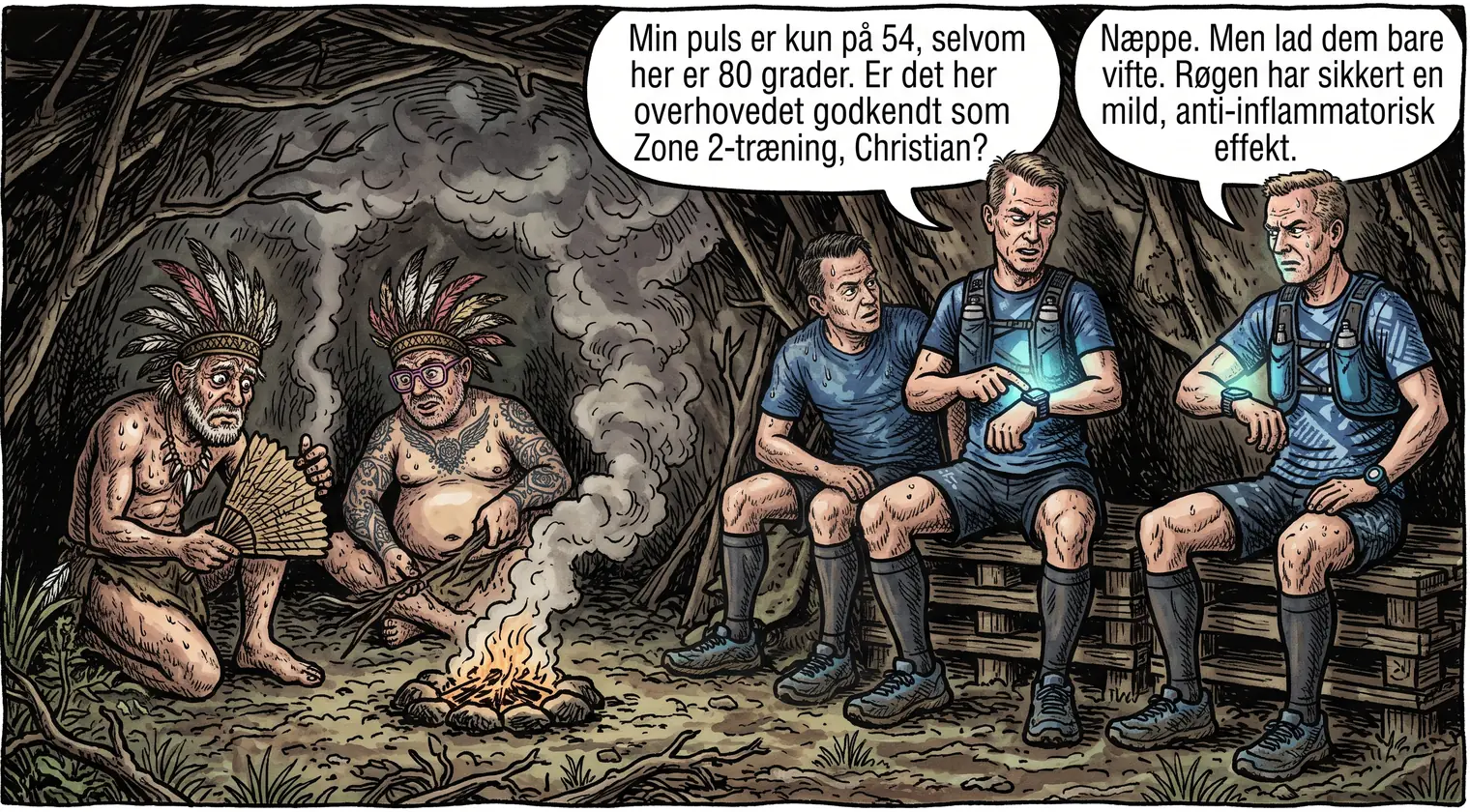
As the Danish sociologist Anders Petersen sharply argues in his reckoning with the performance society, this kind of extreme compulsion to perform has become a means by which the modern individual can prove their absolute, infallible, machine-like self-discipline to capital 1. The body is no longer a lived-in, soft home; it has become a visual spreadsheet, an extended CV. A lean, finely tuned body that has completed an Ironman without a murmur sends an indisputable, performative signal to the market, the competition and the headhunters: Look at me. I have complete, totalitarian control over my own biology. I can set myself inhuman, punitive goals and reach them. I am robust, I never break, and I will work just as hard for the company’s profit as I do for my lactate threshold.
But let us kill off, once and for all, the hardy collective myth these circles hide behind: extreme sport at this level has absolutely nothing to do with health. Forcing your heart, your lungs and your joints through an Ironman is not looking after your body; it is violent physiological overload and breakdown. Research communicated by, among others, the Danish consultant physician Bente Klarlund Pedersen clearly shows that excessive extreme endurance training can over time be downright harmful, leading to scar tissue on the heart and a markedly higher risk of arrhythmia 2. It is not health promotion we applaud at the finish line; it is a self-harming pattern of behaviour that has, bizarrely, become socially acceptable because it is dressed up as 'self-optimisation'.
The Nordic winter dark and the tyranny of the nine-to-five
This compulsive, rigid approach to the body and to performance is reinforced further by the absurdly constructed nine-to-five society we have settled into. From childhood we are forced into a linear, mechanical pattern of performance in which we are expected to deliver exactly the same – with the same energy, the same efficiency and the same smile – every single day. Whether it is high summer, with birdsong and vitamin D in abundance, or we are in the depths of the dark, rain-soaked Scandinavian winter.
When the November dark settles over Denmark like an ice-cold, wet flannel, our biology, our cells and hundreds of thousands of years of evolution scream one thing and one thing only: Hibernate. Save your energy. Sleep more. Withdraw. But what does the Outlook calendar say? It says strategy meeting at 2pm. And what does the little heart-rate monitor on your wrist say? It buzzes irritably and tells you it is "time to move", and that you must go out and run intervals in the sleet if you don’t want to lose your 'streak'. It is comically absurd.
When we sit meekly in front of a screen for eight rigid hours at a stretch under flickering strip lights, drained of daylight and organic meaning, an enormous, unnatural existential deficit opens up in the body. We try blindly to fill this void by punishing ourselves at the gym at 5.30pm.
There we push ourselves to the limit, throw weights about and haul on rowing machines in a desperate, heartbreaking attempt to "feel that we are alive at all". Imagine if we spent all that convulsive energy on something organic, meaningful and genuinely communal instead.
Sexual capital and the digital panopticon
Among the wider population, and among the young in particular, this mad cult of the body takes a slightly different but no less performative form. Here it is purely about sexual capital. At a time when our social lives, our flirting and our very pairing-off play out largely on cold glass screens via Instagram, TikTok and Tinder, visual aesthetics have become our absolutely primary currency 3. We live, as Professor Svend Brinkmann has repeatedly diagnosed, in a society that compels us to stare inwards and constantly monitor our own reflection as the most important project in life 4. Our bodies have been turned into material, into 'content'.
In this light the gym has become the great, cynical mating temple of our age. But it is a temple governed by a market-driven, unrealistic dictate about what an attractive body is supposed to look like in the first place. Being able to bench-press twice your own bodyweight, or keeping your body fat so perilously low that every last abdominal muscle stands out, unnatural and dehydrated, is not physiologically healthy.
It is exhausting, injury-inducing, and demands a dietary restriction that teeters constantly on the razor’s edge of a full-blown eating disorder. We suffer to build a body we can photograph in front of the mirror in the right "anabolic light" and share with our algorithmic audience. Byung-Chul Han aptly calls this a burnout society, in which we, entirely of our own free will, exploit and surveil ourselves to the brink of exhaustion in an endless, stressful hunt for recognition 5. We flaunt the surface while the inside of the soul bleeds out.
Devil’s advocate: Isn’t this just nature’s evolutionary order?
To preserve our critical and intellectual honesty, however, we must listen closely to those who actually defend this limitless physical practice. For is all of this really nothing but cynical capitalist brainwashing, Silicon Valley algorithms and empty narcissism?
Several psychologists, Danish sports psychology among them, will rightly point out that setting yourself enormous, physically demanding goals – such as building a formidably strong body from scratch or finishing a punishing marathon – is one of the most potent tools human beings have for building mental resilience and deep character. When you stand alone at five in the morning and overcome the pain, the fatigue and the inner voice begging you to give up, you build a mental muscle, a psychological 'grit', that carries you safely through life’s real, dark crises 6. Seen this way, the sweat is not meaningless; it is the very foundation of a strong person who does not break in a storm.
Then there is the hard-nosed evolutionary-psychological argument. It can easily look like a modern, claret-swilling intellectual arrogance to give smartphones and capitalism all the blame for our desperate need to attract a mate through massive physical display. As Danish evolutionary psychologists point out, the human animal – exactly like every other mammal on the savannah – has always used physical strength, extreme symmetry and exaggerated aesthetics as the most important instinctive markers of good genes, fertility and the ability to protect and provide 7. That the young man today pumps iron for three hours to get unnaturally broad shoulders, and that the young woman squats heavy to accentuate her biological curves, may not be an expression of modern, screen-based superficiality at all. It is rather a deep, ancient, raw and entirely natural, instinctive mating strategy that is simply playing out on a new set. It is undiluted biology, whether the dance takes place in a muddy cave forty thousand years ago or under halogen spotlights at Fitness World on Amagerbrogade.
Putting down the tyre and coming home
These counter-arguments carry a resounding, important and uncomfortable truth. We must challenge ourselves physically. We should feel the limit of our own endurance in order to grow as human beings, and deep down we are merely biological creatures with an instinctive, animal need to attract, seduce and impress the herd.
The problem – and the deep, existential satire the dung beetle on the floor is laughing at – only arises when this natural, life-giving drive is entirely hijacked by the market. When it is gamified by Apple and Strava, blown grotesquely out of all human proportion and made the main content of our existence. When the line between a healthy, evolutionary awareness of the body and a morbid, app-driven, performative and unhappy self-control is wiped out altogether.
Looking after your body, understanding its fragile mechanisms, working up a sweat and letting your lungs work is an enormously wise and noble calling. But as a society and as individuals we need to start drawing a razor-sharp distinction between movement done out of love for the body and the soul, and movement done purely for the market’s sake.
The next time you drag a pointless tractor tyre across a rubber floor, lift iron in isolation or run in the winter dark while your screen beeps at you, stop for a second and check honestly, right down in your diaphragm. Is this really about the joy of biological function? Is it about being able to carry your children effortlessly on your shoulders, to walk freely in real mountains, or to feel the life-giving, organic tiredness that brings a deep, dreaming sleep – without needing to measure it with an app? Or is it, deep down, about being able to slap some meaningless number on the table in front of your colleagues on Monday?
We must remember to come home to ourselves. We must remember everything that money, closed activity rings and recognition on LinkedIn cannot buy us: the real, warm, sensuous connection with others. Soft, pleasurable, undemanding movement. The community that suddenly springs up when you kick a ball about in the park, dance in a living room or physically build something together, without ever monitoring your own pulse, checking your reflection or documenting it for the network.
The body is not a machine. It is not a shop window. And it is certainly not a spreadsheet to be optimised. It is your home. The question is: can you even remember what it feels like to live and move in it without an invisible digital audience at the back of your mind?
Sources
1. Petersen, A. (2016). Præstationssamfundet. Hans Reitzels Forlag. Borrow at bibliotek.dk
2. Klarlund Pedersen, B. (2018). Sandheden om sundhed. Politikens Forlag. (Sheds light on the limits of healthy exercise and the risks of extreme endurance training). Borrow at bibliotek.dk
3. Hendricks, V. F., & Mehlsen, C. (2019). Se på mig! - Sådan bliver du til noget i en verden af likes. Informations Forlag. (On the attention economy and visual currency). Borrow at bibliotek.dk
4. Brinkmann, S. (2014). Stå fast - et opgør med tidens udviklingstvang (Stand Firm: Resisting the Self-Improvement Craze). Gyldendal. (A diagnosis of the constant focus on optimisation and the surveillance of the self). Borrow at bibliotek.dk
5. Han, B.-C. (2015). Træthedssamfundet (The Burnout Society). Forlaget Mindspace. (A classic on how, in modernity, we exploit and surveil ourselves as our own slave-drivers). Borrow at bibliotek.dk
6. Henriksen, K. (2015). Præstér under pres - guide til mental styrke i sport, kunst og erhvervsliv. Dansk Psykologisk Forlag. (Dissenting source: argues for the character-building effect of extreme goals and of physical and mental robustness). Borrow at bibliotek.dk
7. Høgh-Olesen, H. (2007). Menneskedyret. Syddansk Universitetsforlag. (Dissenting source: the evolutionary-psychological case that physical appearance and strength are innate, biological mating strategies and not merely capitalist constructions). Borrow at bibliotek.dk