The market and the unmeasurable, part 3 of 4 · 7 min
Measuring the unmeasurable – why the market only understands half of reality
By Steven Wensley, MA in history, and poet.
We live in a civilisation that has fallen blindly in love with the measurable. Since the Industrial Revolution we have built a society around the assumption that if something cannot be counted, weighed, evaluated or priced, it barely exists. We measure the health of nations in gross domestic product, we measure our work in KPIs (Key Performance Indicators), and increasingly we measure ourselves and our bodies in steps, sleep routines and calorie intake. Capitalism has made us masters at optimising the surface. But in this collective counting mania we have lost sight of everything that actually gives human life its value. We have reduced reality to a spreadsheet, and we all suffer the consequences for our relationships, our bodies and our communities.
To grasp the depth of this crisis – and to understand how we might create an alternative – we have to look at how we map reality in the first place. Here the integral model, and its four quadrants in particular, offers a precise lens through which to view our modern blindness.1 The model divides reality into the inner and the outer (interior and exterior) and the individual and the collective (individual and group).
Chairs, plates, hours. This part is going very well.
Shoulders dropping. Forgetting to keep an eye on the time.
Someone has done the shopping. Someone has baked. The roof is more or less watertight.
A story takes a detour. We stay a little longer.
We can certainly tally up the evening.
The question is what is missing once we have.
See the four views of the same evening.
The four views are the four quadrants of the integral model. The model is Ken Wilber’s. See note 1.
Interior“This is the ‘invisible’ half of reality, which the market can neither price, control nor understand.”
Exterior“Capitalism’s massive success comes from having conquered this right-hand side of reality completely.”
Inner life · individual
I
“This inner life cannot be clocked or reduced to a formula.”
Further reading: Reclaiming the body from the market, Sleep as performance
Exterior · individual
It
“This is where we optimise ourselves as resources.”
Further reading: The body as performance (the series)
Interior · collective
We
“It is the invisible glue that binds people together in a space of trust.”
Further reading: From transaction to relationship, The transactional straitjacket
Exterior · collective
Its
“This is the market’s playground.”
Further reading: Five concepts we speak from
The arrows
“The mistake our society makes is trying to colonise the left-hand side with tools from the right.”
- “We try to numb our existential meaninglessness (the ‘I’) by consuming material goods or therapy (the ‘Its’).”
- “We think we can ‘buy’ ourselves a good workplace culture through team-building courses paid for out of the HR budget.”
Market forces, technology and the capitalist system excel almost exclusively in the two quadrants on the right-hand side of this model: the exterior and the objective.
In the upper right quadrant – the individual and exterior (“It”) – we find the physical brain, our biology, our organism and our measurable behaviour. This is the domain of objective science, of empiricism and of behaviourism. Here everything can be observed from outside, statistics can be kept, and targets can be set. This is where we optimise ourselves as resources.
In the lower right quadrant – the collective and exterior (“Its”) – we find the great social systems, our environment, ecosystems and, not least, our economy. Here interobjective structures, systems theory and cybernetics hold sway. This is the market’s playground. It is the infrastructure, the legislation and the endless stream of transactions.
Capitalism’s massive success comes from having conquered this right-hand side of reality completely. It has created unimaginable material wealth and technological progress by seeing everything in the world – trees, time, relationships and people – as objects in a system that can be priced and optimised. The trouble is that this “business ontology” has persuaded us that the right-hand side of the model is the only reality. The system believes it can solve any problem with an economic incentive structure or a new behavioural metric.
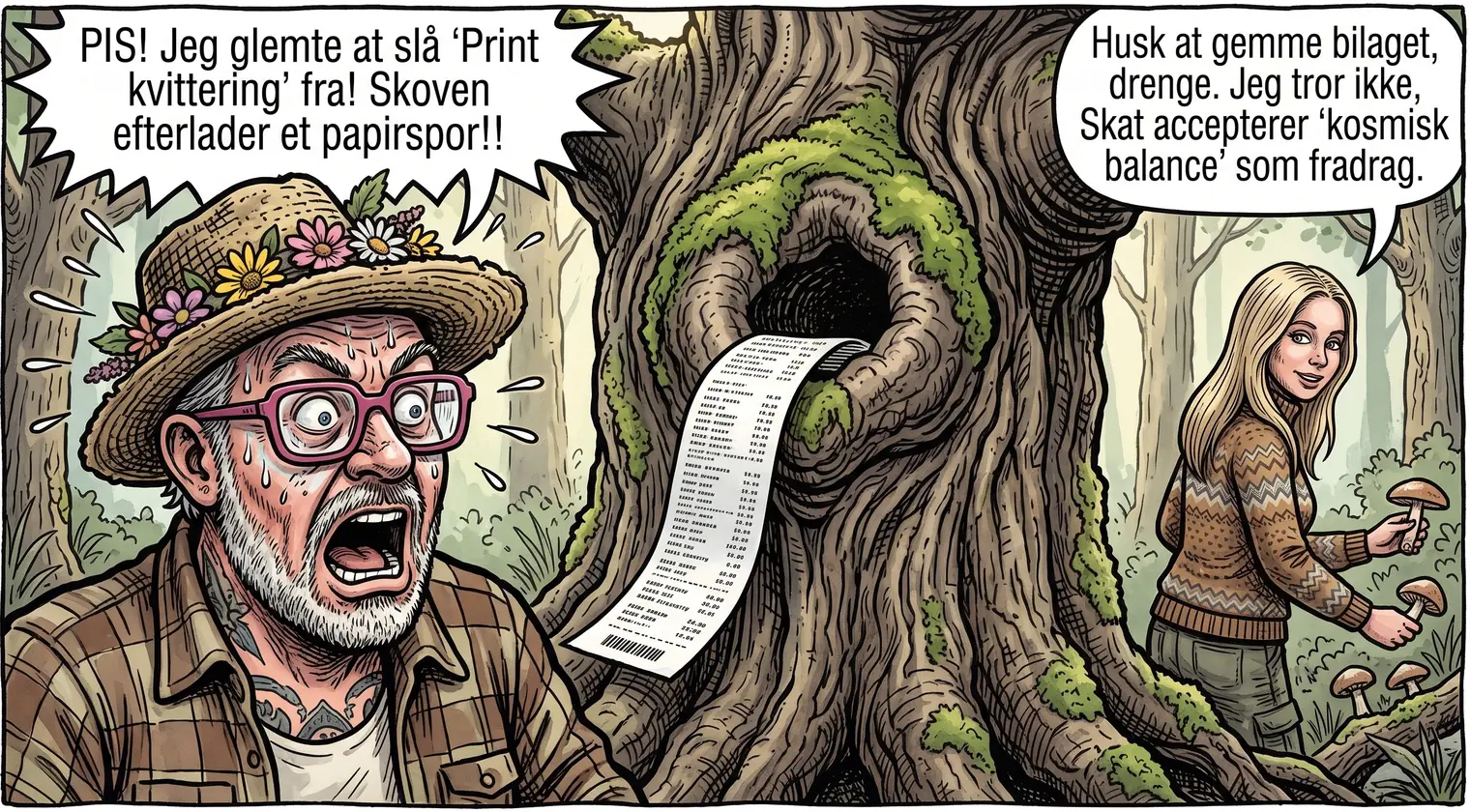
But the system fails utterly when we turn our gaze to the two left-hand quadrants – the inner, the interior. This is the “invisible” half of reality, which the market can neither price, control nor understand.
In the upper left quadrant – the individual and interior (“I”) – lives our subjective reality. This is where we find our human consciousness, our feelings, our psychology and our experience of ourselves. It is the space for spirituality, deep purpose, values and the sense of having a calling in life. This inner life cannot be clocked or reduced to a formula. A deep feeling of grief, a sudden creative impulse or a state of pure bodily calm has no exchange value on a market, and so in the capitalist system it is usually ignored or pathologised.
In the lower left quadrant – the collective and interior (“We”) – we find our intersubjective reality. This is where shared culture, our worldview, our morals and our deepest common values arise. It is art, music and the real, lived culture of a workplace and a sense of community. It is the invisible glue that binds people together in a space of trust.
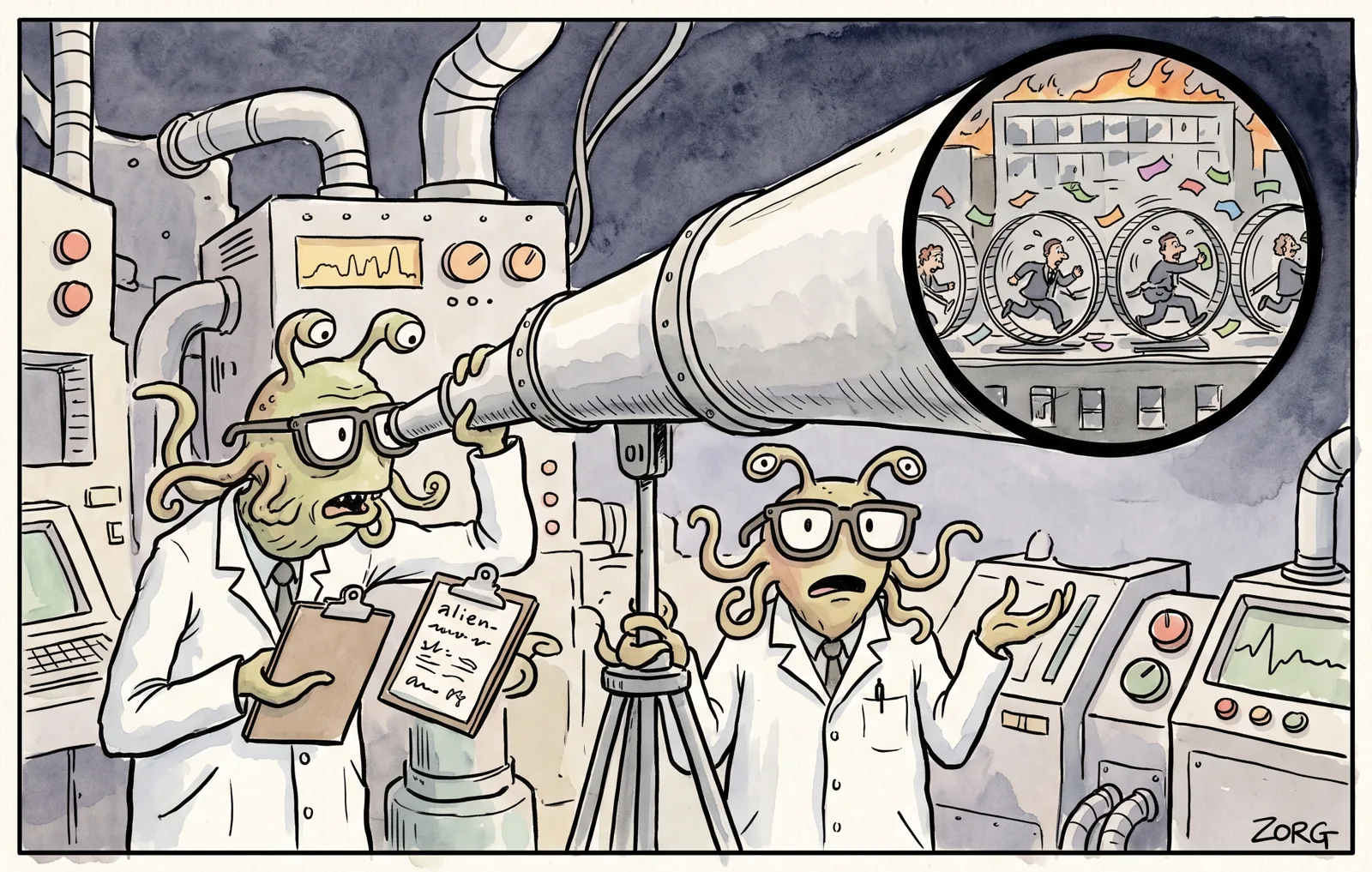
The mistake our society makes is trying to colonise the left-hand side with tools from the right. We think we can “buy” ourselves a good workplace culture through team-building courses paid for out of the HR budget. We try to numb our existential meaninglessness (the “I”) by consuming material goods or therapy (the “Its”). We instrumentalise our relationships and look on other people as a “network” that can get us advantages, rather than meeting them in an authentic “We”. Money acts as a barrier that converts every deep, qualitative human relationship into a shallow, quantitative transaction. When there is always money between us, we need not trust one another, we need not engage, and we need not be vulnerable. We pay, and the relationship is concluded.
At Vendhjem we are experimenting with the radical move of severing the economic, transactional layer from human relationship altogether. The place is a free zone from market forces, bought free of the bank, which means the logic of the right-hand side loses its power at the door. You cannot pull out a plastic card and consume your way to a place here. Money is useless as a ticket. The only way you can stay here is by co-creating your way in – as a guest, as a volunteer, as the facilitator of your own programme, or as a resident.
When you deliberately remove the option of paying your way out of responsibility, attention is inevitably forced over to the left-hand, invisible side of the integral model. Without money as a middleman, we cannot “buy” ourselves a shared worldview or a culture (“We”). We are forced to create it ourselves. If the long table is to be laid, the food cooked and the roof kept watertight, we have to talk to each other. We have to negotiate our morals, our values and our shared culture directly with one another. That demands a vulnerability and a presence from which capitalism normally excuses us.
At the same time, this absence of any demand for perpetual productivity opens the way to a deep bodily and psychological healing in the “I”. When you are not inside a system that judges you solely on your behaviour, your objective performance or your financial status (the right-hand side), your subjective consciousness has room to unfold. Vendhjem preaches no answer key to how one ought to live. There is no guru laying down strict rules. What is offered instead is the setting: healthy, clean food, soil under the fingernails, bodily and somatic work, and direct contact with nature. It is a space in which to feel your own inner purpose, your feelings and your existence – entirely free of any demand to optimise it or report it on to an app.
Operating in a moneyless community is a direct rejection of the premise that a human being is merely a cog in a production machine. It is an insistence on reclaiming the whole of reality. When the sweat drips during a building project, or when we share a meal we have harvested and cooked ourselves, we bring an ancient form of trust back to life. We rediscover that real security is not found in a bank account but in the intersubjective bond between people who know they can count on one another.
Money, historically speaking, is not the root of all evil, but the commercialisation of everything living is what stifles our creativity and makes us strangers to ourselves and to one another. To heal that split we must create enclaves in the world where the market has to stop at the fence. Where the body is allowed to be a body, where consciousness is allowed to be consciousness, and where we can once again meet one another in the strong, invisible left-hand side of reality. Only there, when the price tag is torn to pieces, do we truly find out what – and who – we actually are.
Source
1. Wilber, K. (1995). Sex, Ecology, Spirituality: The Spirit of Evolution. Shambhala.