The body as performance, part 1 of 6 · 6 min
Performative discomfort
By Steven Wensley, MA in history, and poet.
The water is two degrees, the air is sharp, and the moment your body breaks the dark surface, everything else disappears. The regrets of the past and the endless to-do lists of the future are wiped out in a split second. There is only the cold shock, the gasping breath and the heart’s insistent pounding against the ribcage. It is a brutal but deeply honest awakening. It is here, in the icy deep, that many of us experience a rare magic: we come home to the body. For a while we are not our titles, our worries or our productivity. We are just flesh, blood and survival. The somatic encounter with nature is pure.
But for many of us this magic has acquired a companion. Down in the ice water, right beside the trembling, living body, hovers the lens of a smartphone on a selfie stick. And with the little camera’s presence, the whole nature of the act changes. What could have been a deep, private and healing pleasure is now converted into digital proof. We have captured the moment – not primarily to keep it inside ourselves, but so that we can put it on display.
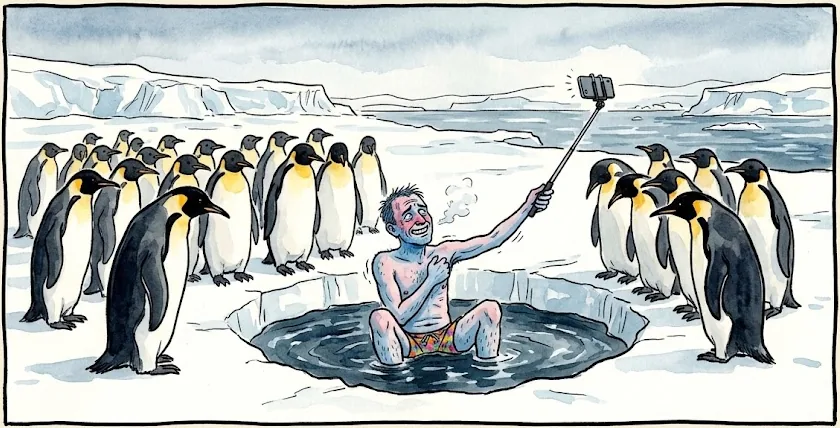
At heart we are enormous advocates of every practice that pulls us out of our heads and down into our bodies. Feeling the somatic is the very core of being human; it is our anchor in a fleeting world. Winter swimming can be a fantastic, life-affirming shortcut to exactly that. But it is crucial to cast a critical eye over how even the most primal, nature-bound experiences are swiftly captured and instrumentalised by a performance-driven, capitalist system.
In a society where we must constantly optimise ourselves to keep our value and stay relevant, winter swimming is quickly made into a symbol of superiority. When a picture of the icy deep is shared on social media, often accompanied by buzzwords about "resetting the nervous system", it is rarely just a tribute to nature. It is a performative signal to the network and the labour market:
Look at me. I possess a willpower that surpasses yours. I am extremely disciplined, I can tolerate physiological discomfort, and therefore I am a resilient winner. The cold shock is made into proof of the ability to perform and to overcome. The body is reduced from a home you feel and listen to into a shop window that must yield a return in the form of likes, admiration and 'symbolic capital'. The self-optimising act becomes yet another job we do in order to win the status game.

To understand the phenomenon’s massive grip on us, we must also look at the science so often wielded as an unanswerable argument for the trend. The advocates are many, and the evidence for the benefits is certainly there. Globally, figures such as Wim Hof have turned cold exposure into a full-blown movement, and researchers have documented how the cold shiver, especially when followed by natural rewarming, can activate brown adipose tissue, release massive quantities of endorphins and dopamine, and potentially improve circulation. For many it is a physiological revelation that eases tension and brings an enormous, undiluted pleasure into everyday life.
But there are also strong scientific voices urging caution, who refuse to make the ice bath a universal miracle cure. Cardiologists regularly remind us that the violent cold shock can trigger serious arrhythmias in predisposed individuals. At the same time, several stress researchers point to a deeper, existential paradox: if you are already living a hyper-optimised, busy life with a nervous system that is in a constant state of alert, it is far from certain that yet another extreme physiological shock is what your body is really calling for. The cold releases cortisol and adrenaline – the body’s primary stress hormones. For some it is a healthy form of 'microstress' (hormesis) that makes the system stronger. But for others it is merely one more aggressive crack of the whip on an overloaded body that, in truth, is only begging for gentleness, rest and warmth.
Personally, I have always found it hard to lower myself into ice water. It has felt so unpleasant that it has often only worked when I forced myself to, so as not to lose face in front of others. But then, I must grudgingly admit, the effect has been enormously positive. I mention it only to underline the psychological mechanisms that can also be at play.
Herein lies the absolute heart of the matter: it is enormously important that the individual does not feel massive outside pressure to submit to a specific, extreme practice just to appear "healthy", "strong-willed" or "right". Your way back to the body must always start from your unique journey and your specific needs on the day in question – not from what the algorithm or the collective scramble for status dictates. There is no shame in opting out.
There are countless, and often far quieter, ways of coming home to the somatic. For some it is the ice water. For others it is the slow, deep heat of a sauna. It might be an aimless walk in the woods without a step counter, stretching on the living-room floor, or simply closing your eyes and breathing all the way down into your belly. None of this necessarily earns social capital. None of it lends itself to a sharp, enviable post on LinkedIn. And perhaps it is precisely the absence of an audience that makes these acts so infinitely valuable. They are untainted. They belong to you alone.
If you love lowering your body into the freezing sea, feel the calm spreading afterwards and sense a deep, instinctive joy, then it is a beautiful practice. Nature and body together are magnificent. The problem is not the ice bath itself, but the systemic pressure that turns it into yet another performance.
Next time you stand at the edge looking down into the dark water, ask yourself a simple but mercilessly revealing question before you jump in: Would I still do this if there were no cameras, and if I could never, ever tell anyone about it?
If the answer is a resounding yes, you are on your way home to yourself. If the answer is no, you may not be feeling your body at all. You are just feeding the machine.