The body as performance, part 2 of 6 · 5 min
The body’s silent language
By Steven Wensley, MA in history, and poet.
You are sitting at your desk, and your stomach growls. Not a quiet, polite reminder but a deep, insistent rumble that spreads upwards from the diaphragm. Your body is speaking its oldest, least ambiguous language: I need nourishment. But instead of reaching for lunch, you look down at your wrist. The screen lights up and shows a circle that is almost closed. There are 42 minutes left of your 16-hour fasting window. You take a sip of black coffee, ignore your body’s plea and wait for the algorithm to give you permission to eat.
Fasting, in its purest form, is a beautiful, ancient practice. For millennia people have fasted for spiritual, health and entirely natural, seasonal reasons. Letting the digestive system rest can be a deep, healing shortcut to sensing oneself. It sharpens the senses, and it teaches us to tell genuine, physiological hunger from the restless hunger of boredom that so often marks our modern society of plenty. Feeling your body’s natural rhythms and forgoing constant consumption can be a powerful, somatic experience. It is a way of peeling away the noise and coming home.
But something has slipped in our modern embrace of the phenomenon. What ought to be a fine-tuning of our inner compass has been hijacked by the culture of optimisation and the instrumentalising capitalist system. Fasting has become 'Intermittent Fasting', put into tight, spreadsheet-like boxes such as 16:8 or 20:4, complete with apps that celebrate you with virtual confetti when you have starved yourself for long enough. The practice has been gamified. And all at once it is no longer about listening to the body but about subjecting it to a strict technological diktat.
In this status-driven age the fasting window has become a performative discipline. Being able to skip breakfast and live on black coffee and iced water until two in the afternoon has become bodily proof of superior control. It signals to the network that you are a person of willpower, that you are above base, animal urges, and that you have energy to spare to 'hack' your own biology. We take our hunger hostage to win the eternal struggle for status. The body is no longer a wise organism we cooperate with; it is an unruly mount to be broken with stopwatches and discipline, so that we can appear slim, delectable and hyper-efficient.

Science is often used as an impenetrable shield against all criticism. And there is certainly substance to be had. Leading researchers point to time-restricted eating as a potential key to everything from improved insulin sensitivity to autophagy – the cellular clean-up process in which the body breaks down and recycles damaged cells. For many people a fixed eating window makes enormous sense. It does away with late-evening snacking, gives a feeling of lightness in the digestive system and creates a mental clarity that is hard to find when blood sugar is constantly going up and down.
But the picture is far from clear-cut, and experts in nutrition and physiology are increasingly sounding the alarm when fasting is made into a universal religion. Several endocrinologists and experts in female physiology point out that the popular fasting protocols have mainly been tested on male mice and male test subjects. For women, especially of childbearing age, strict fasting can stress the endocrine system, disrupt hormonal balance and, at worst, lead to missed periods. Psychologists and dietitians also warn that for many people the fixed time frames serve as a socially acceptable door into disordered eating, in which you lose altogether the ability to feel your own natural signals of hunger and fullness.
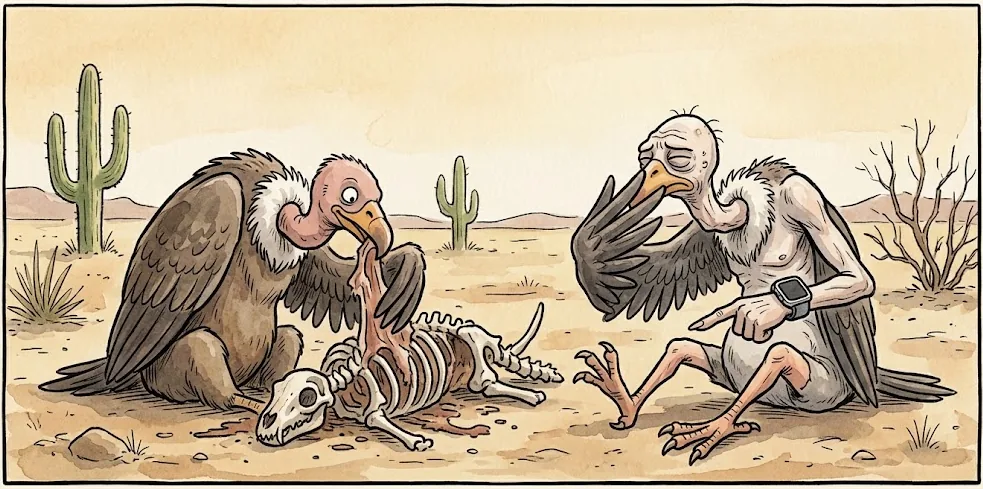
This is where the absurdity of our culture shows most plainly. It is like the emaciated vulture in the desert, frantically clamping its beak shut beside a freshly killed meal simply because a blinking watch on its leg dictates that the intermittent fasting window is not yet open. We have outsourced our bodily sovereignty to a piece of technology developed in Silicon Valley. We have become so afraid of losing control and slipping down the rankings that we would rather let a screen tell us whether we need energy than listen to our own cells.
There are many ways of coming home to one’s body, and fasting can certainly be one of them. But it requires the practice to spring from an inner resonance, not from outside pressure. It is crucial that each individual pays attention and starts from their own biology, cycle and circumstances. If fasting gives you energy, calm and a sense of being connected to yourself without strain – then that is wonderful. But if it gives you stress, cold hands, a constant churn of thoughts about food and a guilty conscience, you are overstepping your body’s limits to fulfil a theoretical ideal.
We must dare to take back power over our own biology from the market and from the screens that try to reduce our nature to a formula. Health is not only a matter of fasting for long enough but just as much of being able to eat a slice of dark wholegrain bread when your cells call for it, without feeling that you have failed your optimisation project.
Next time your stomach rumbles hard and you glance at your watch to see whether you are 'allowed' to eat, ask yourself this simple question: Would you still push through the last two hours of your fast if your app couldn’t log your streak, and you were never, ever allowed to mention your eating window to anyone?