The Yardstick, part 2 of 6 · 7 min
Two brushes
By Steven Wensley, MA in history, and poet.
Why do we have a set of rules that hits an unemployed person who paints the association's house at the weekend? That is the question. Swinging a brush, replacing a roof board or patching a bicycle to help a local community has for millennia been the very glue of human life together. It has not become illegal. It has become measured.
Undeclared work exists
Let me begin with what cannot be explained away. Undeclared work exists, and it costs. The Rockwool Foundation has counted it for decades. But the figures also say something other than what you hear in the debate. Almost three quarters of undeclared work is done for friends, acquaintances and family: 48 per cent for friends and acquaintances, 26 per cent for family.1 And the most common form is not cash in an envelope. It is favours paid back with favours. They make up almost half of all undeclared income.
Rockwool explicitly counts “neighbours who help each other paint their respective carports” as undeclared work. And the researchers themselves write that favours between friends are “probably not regarded as tax evasion to the same extent”.
So the myth is not that undeclared work exists. The myth is that it is an underground society. Most of it is two neighbours, each with a brush.
Nobody is hunting your neighbour
Here I must be honest too. It is tempting to write that the state encourages us to report our neighbours. That is not true. The Danish Tax Agency has a page where you can report suspected tax fraud and undeclared work. But on its own page about favours between friends, the same agency writes that it is “normally also tax-free” if you “help a good friend build a carport”.2 And when it began checking money transfers made through a payment app, it wrote: “you will not come under our scrutiny if you collect money for a joint present”.
Nobody is hunting your neighbour. They do not need to. The yardstick does the work. It sits in our heads before we have lifted the brush: Is this a favour or an exchange? Have we agreed something? Dare I let him sleep here? The greatest control is not the one the state exercises. It is the one we learn to exercise on ourselves.
The paint bucket
The clearest place where the yardstick is written down is the rules on unemployment benefit. And they are not as simple as I thought.
An unemployed person may give an association 44 hours a month without losing a single krone of unemployment benefit.3 It is a good rule. But it does not cover everything. Work that “concerns primary operation and maintenance” results “as a starting point in a deduction from the first hour”. The guidance names the examples: “Taking care of the daily cleaning. Painting. Plumbing. Electrical work. Carpentry.”
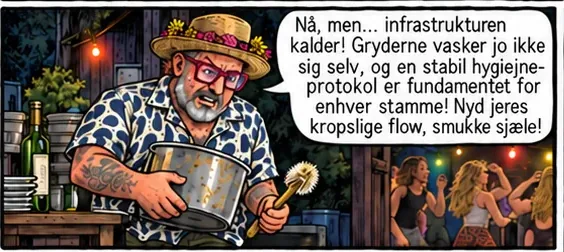
So you may well be a volunteer. Just not with a brush in your hand.
There is an exception, and it is worth reading. In “smaller organisations”, maintenance does not result in a deduction if five conditions are met: the work corresponds to ordinary maintenance of your own home, it happens occasionally, it has always been done by unpaid people, it is also done by unpaid people in similar associations, and it requires no authorisation. The guidance's own example is “Painting the clubhouse or the scout hut”.
What is a “smaller” organisation? It does not say anywhere. Neither the executive order nor the guidance defines the word. That is not an accusation against the caseworker who has to interpret it. It is an accusation against a rule that leaves the most decisive word empty.
And one more thing, in fairness: the unemployed person who paints is not a cheat. He has to report his hours, and the unemployment fund then deducts them. Fraud requires giving false information or withholding something.4 The price of painting is not an accusation. It is a calculator.
Two brushes
Now it gets interesting. For the same state has another brush.
Someone on social assistance can be offered community work. The law says it plainly: the offer is made “so that the person shall work for their benefit”.5 And there is a rule for which tasks it may involve: “The tasks under the offer must lie beyond the standard level of task performance at the public employer.”
The ministry's own guidance on the work obligation gives an example of a project: “extra supervision and minor maintenance of tables and benches, rubbish bins, paths, bus shelters etc. in public areas”.6 In Copenhagen, people in community work paint facades and maintain tables and benches along Sydbanestien.
Put the two rules side by side.
The compelled brush may only paint what nobody would pay for. The voluntary brush is penalised if it paints something somebody could pay for.
It is the same yardstick. It is just held the other way round.
And the guidance on the work obligation has one more sentence: hours “where the person does unpaid work, e.g. voluntary work in an association” do not count towards the 37 hours. The work obligation knows two kinds of hours: those the job centre has ordered, and those an employer has paid for. The hour you give your association of your own accord does not exist in the sum.
Right now a person on unemployment benefit can only be placed in community work to test whether he is available for work. In a bill of October 2026, the government proposes that people on unemployment benefit may in future be placed in community work without that condition.7 If it is passed, the same unemployed person can be sent out to paint a bench for the municipality and get a deduction for painting his association's house.
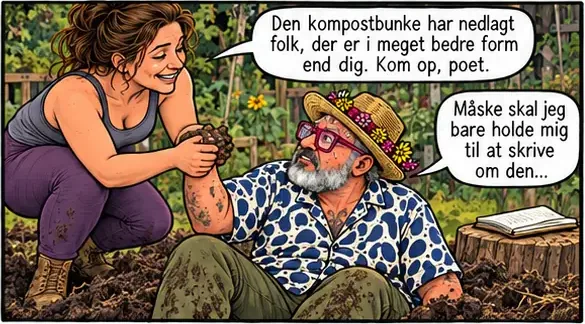
The yardstick was made to protect the painter
It would be easy to make this a story about malice. It is not. The guidance itself says why the rule exists: it must be ensured “that the activities of unemployed members do not limit the supply of work through the unemployed carrying out tasks that could otherwise have been offered as paid work”.
The rule is written to protect the painter who makes a living from painting. That is a decent purpose. The tragedy is that the only way the rule can protect the painter is by asking whether the gift could have been an invoice. The yardstick was made to measure wages. Now it measures kindness too.
One krone over
The yardstick has a peculiar property: it does not measure gradually. It cuts.
A volunteer in an association may have their expenses covered tax-free at fixed rates. In 2026 that is 10,000 kroner a year, combined for phone, internet, office expenses and special clothing. But if the allowance goes over the rate, “all allowances paid to the person concerned become taxable”.8 Not the excess. All of it.
For a volunteer on unemployment benefit it happens twice. The guidance: the amounts become taxable “and therefore result in a deduction for the full amount”.
One krone over the rate, and the whole thing changes its name. The phone, the postage and the sports kit are now called wages.
The fifteen-year-old
Now a little riddle.
A fifteen-year-old looks after the neighbour's children and is paid in cash. It is tax-free. The law says expressly that “remuneration to a person under 16 as payment for work” in a private person's home is not included.9
Two mothers in the same block agree to take turns looking after each other's children. That is an exchange, and according to the Danish Tax Agency “both parties must pay tax on the value of the service you receive”.
Money to a fifteen-year-old goes free. An agreement between two mothers does not.
That is the yardstick in its purest form. It cannot see care. It can see a payment, and it can see an exchange. If the two mothers help each other when it suits, without agreeing anything, it is a favour between friends, and they go free. But the moment they talk about it in advance, it becomes a trade.
One day a year
Finally, something that ought to make us glad. The last Friday in September is the national day of voluntary work.10 The finance act for 2026 puts 52.8 million kroner in a fund for voluntary social work, and the fund's own definition of voluntary work is that it happens “without compulsion”. In 2024, 40 per cent of Danes had done voluntary work within the past year. Volunteers on social assistance and disability pension give on average more hours a month than the rest of the population.
And then there is the strange thing: I have not been able to find an official figure for what all that work is worth in kroner. Neither Statistics Denmark nor VIVE has one. It cannot be priced.
The only thing we have not put a price on is the thing we celebrate. The week after, that is exactly what the rules ask about.
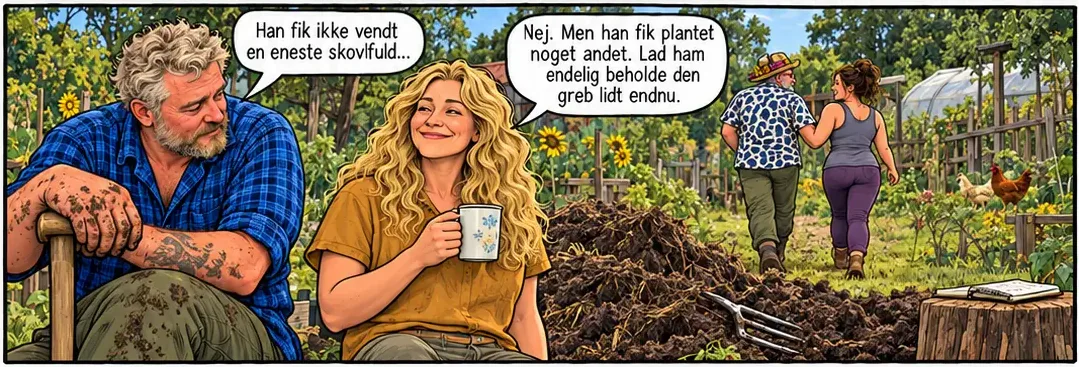
In the next part we lift our eyes from the paint bucket to those who have never held a brush: the dividend tax case, the accounting firms and a state that for years could not find the market price of our own houses.
1. The Rockwool Foundation Research Unit, «Sort arbejde er steget fra 2016 til 2017» (Undeclared work rose from 2016 to 2017) (2018), and «Sort arbejde udføres af hver femte dansker og koster staten milliarder» (Undeclared work is done by one Dane in five and costs the state billions) (2025). 2018 · 2025
2. Danish Tax Agency, «Familie- og vennetjenester» (Favours for family and friends) and «Anmeld mistanke om skattesnyd, sort arbejde og ulovlig arbejdskraft» (Report suspected tax fraud, undeclared work and illegal labour). The quotation about scrutiny is from the Danish Tax Agency's press release of 11.11.2021 on checks of money transfers. Favours · Reporting · The press release
3. Executive Order no. 39 of 12.01.2026 on the payment of unemployment benefit, section 17(3), (4) and (6), and the Guidance on the payment of unemployment benefit, VEJ no. 9127 of 20.01.2026, on sections 15 and 17. The executive order · The guidance
4. Executive Order no. 39/2026, section 17(8) (the duty to report) and section 27 (the deduction), and the Unemployment Insurance Act, sections 86 and 87 (repayment, and fraud through false information or concealment). The Act
5. Act on an active employment effort, Consolidated Act no. 280 of 01.03.2024, sections 82 and 83, as amended. retsinformation.dk
6. Start-up guidance on the work obligation, SKR no. 10228 of 30.12.2024. City of Copenhagen, reply to Christian Bülow on community work, 6.3.2026. The guidance · City of Copenhagen
7. Bill on an active employment effort, L 61, introduced 8.10.2026, explanatory notes section 2.15.2.1. It is a bill, not law in force. retsinformation.dk
8. Section 7 M(1), third sentence, of the Danish Tax Assessment Act, as amended by L 36 A (adopted 12.11.2026, effective from 1.1.2026): 7,250 kroner at 2010 level, 10,000 kroner in 2026. Before, there were three rates totalling 6,800 kroner. Executive Order no. 1185 of 19.11.2024, section 5, and VEJ no. 9127/2026 on section 17. L 36 A as adopted · The executive order · The Danish Tax Agency's rates for 2026
9. Danish Tax Assessment Act, Consolidated Act no. 1500 of 24.11.2025, section 7 Å(1) and (2), and the Danish Tax Agency on favours for family and friends. Tax Assessment Act · skat.dk
10. borger.dk on Frivillig Fredag (Volunteer Friday). Guidance on the application fund for voluntary social work 2026, VEJ no. 9271 of 20.02.2026. VIVE, the Volunteering Survey 2024. Statistics Denmark on voluntary work (survey data, no estimate in kroner). borger.dk · The fund · VIVE · Statistics Denmark