Skip to content
What money can't buy

DAEN

Reading list

A library about money, about what it does to us, and about those who have thought and lived without it.

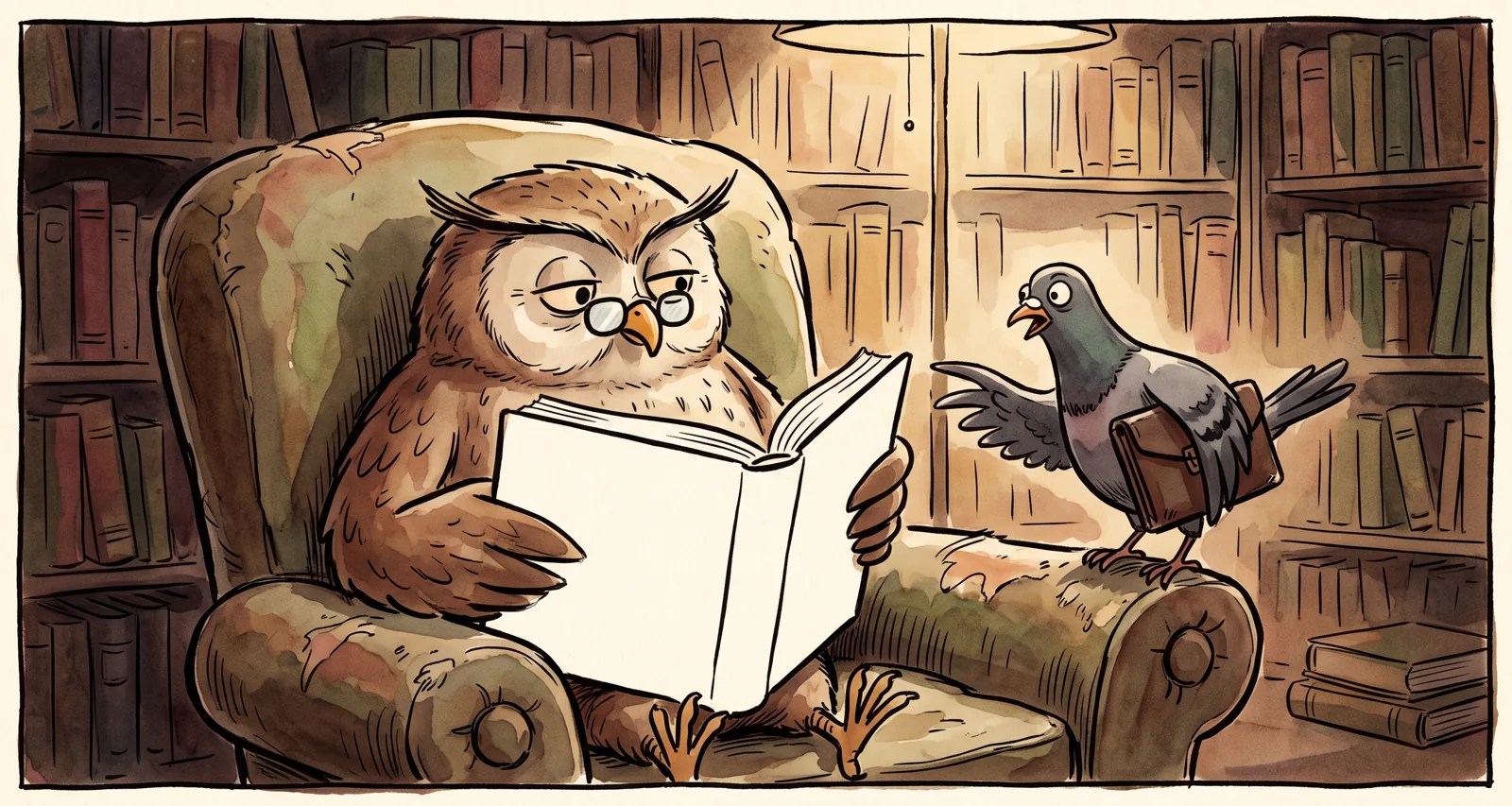
An owl in glasses sits in a worn armchair in a library, reading a thick book. A pigeon with a shoulder bag stands on the armrest, trying to sell it something.
“No thanks. This one doesn’t need updating.”

00

Start here

Six books we stand on ourselves. If you only want to read one, take Sandel. If you want to understand where the critique comes from, take Marx’s pages on money, all four of them.

Georg Simmel — Pengenes filosofi (Philosophie des Geldes, 1900; English: The Philosophy of Money)

Simmel was one of the first to map how money reduces qualitative, human differences to a purely quantitative question: what does it cost? He shows how this breeds cynicism and a cold distance between modern people. And he is honest about the price in the other direction: money is also what frees the peasant from the lord of the manor. Freedom and flattening are the same coin.

No complete Danish edition. The essay “Pengene i moderne kultur” appears in “Simmel – sociologiens eventyrer” (Samfundslitteratur 2019). · Full German text · Borrow at bibliotek.dk

Karl Marx — Økonomisk-filosofiske manuskripter (Economic and Philosophic Manuscripts), the section “Om penge” (1844)

This is the very root of the critique. Marx describes money as the “universal pimp” that distorts our nature, because it forces us to see one another as means to an end instead of ends in themselves. The ending turns it round: assume man to be man, and love can then only be exchanged for love, trust for trust.

Villy Sørensen’s translation in “Økonomi og filosofi. Ungdomsskrifter” (Gyldendal 1962). The section is freely available online. · English · Borrow at bibliotek.dk

Mark Fisher — Kapitalistisk realisme (Capitalist Realism, 2009)

A modern classic on how the capitalist model hollows out creativity, alienates us and creates a culture of stress and perpetual competition, in which it has become easier to imagine the end of the world than an alternative to capitalism. Fisher calls it reflexive impotence: you know perfectly well that things are wrong, and know at the same time that there is nothing you can do about it.

Antipyrine & Passive/Aggressive 2021, translated by Mathias Ruthner. · Borrow at bibliotek.dk

Michael Sandel — What Money Can't Buy: The Moral Limits of Markets (2012)

Close to required reading for this project. Sandel shows concretely what happens when market thinking pushes into spheres such as friendship, education, health and civic duty, and how a price tag can in itself hollow out the moral value of an act. We have gone from having a market economy to being a market society.

Not translated. The 2012 article in Information is headed “Markedsøkonomi er ikke værdineutral”. · Talk, 15 minutes · Borrow at bibliotek.dk

Charles Eisenstein — Sacred Economics (2011, revised 2017)

Sketches the transition from a growth-based, interest-bearing economy to a modern gift economy, in which relationships once again rest on the survival of the community rather than on individual accumulation. His money is meant to rot like bread, so that nobody gains anything by hoarding it.

Not translated. The whole book is free online, as a gift. · Borrow at bibliotek.dk

↑ Themes

01

When money devours relationships

The same thought recurs from Aristotle to the present day, only in new words: money makes the incomparable comparable, and that very property is what both liberates and destroys. Here are those who have put it best.

Aristotle — Politikken (Politics), book I (c. 330 BC)

This is where the Western critique of money begins. Aristotle distinguishes between household management, where you acquire what you need, and money-making for its own sake, which has no limit. Usury, money that breeds money, he calls the most unnatural form of wealth, because money was meant for exchange, not for breeding.

“Statslære”, translated by W. Norvin and P. Fuglsang (1946). “Etikken”, translated by Søren Porsborg (Akademisk Forlag 2000). · On Aristotle at lex.dk · Borrow at bibliotek.dk

1 Timothy 6:10 — the misquoted verse

It does not say that money is the root of all evil. It says that the love of money is, and in the Greek there is not even a definite article: a root, not the root. Matthew 6:24, on the other hand, is sharper than people remember. It is not a caution about money, it is an either-or between two masters.

The Greek original

Georg Simmel — Storbyerne og det åndelige liv (The Metropolis and Mental Life, 1903)

The short, readable way into the major work. The city is the home of the money economy, where every relationship is an exchange, and the blasé attitude, the sense that nothing makes any difference, is the psychological imprint of everything being measurable in the same unit. Simmel calls money the most frightful leveller.

In “Hvordan er samfundet muligt?” (Gyldendal 1998) and in “Simmel – sociologiens eventyrer” (Samfundslitteratur 2019). · English · Borrow at bibliotek.dk

Max Weber — Den protestantiske etik og kapitalismens ånd (The Protestant Ethic and the Spirit of Capitalism, 1904–05)

Most people know the thesis: ascetic Protestantism gave capitalism its work ethic. What matters for us is the ending. Once the religious meaning has evaporated, the compulsion remains. And the “iron cage” is a translator’s invention; Weber wrote of a steel-hard casing.

Hans Reitzels Forlag 2018, the first complete translation, by Hans Henrik Bruun. · Borrow at bibliotek.dk

Karl Polanyi — The Great Transformation (1944)

Land, labour and money are “fictitious commodities”: things not produced for sale, but which market society treats as if they were. The economy used to be embedded in social relations; the self-regulating market tears it loose and subjects society to the laws of the market. Then society defends itself.

Not translated. · Danish introduction in Slagmark

Walter Benjamin — Kapitalismen som religion (Capitalism as Religion, 1921)

Two pages, written in 1921, first printed in 1985. Capitalism is not merely shaped by religion; it is one: a cult without dogma, without holidays, which does not atone for guilt but produces it. In German, guilt and debt are the same word, Schuld, and the whole fragment lives off that.

In the anthology “Kapitalisme som religion”, ed. Mikkel Bolt and Dominique Routhier (Nebula 2015). · Norwegian translation · Borrow at bibliotek.dk

Guy Debord — Skuespilsamfundet (The Society of the Spectacle, 1967)

It is no longer just things that replace relationships, but images of things. Thesis 4 is the most precise sentence anyone has written about instrumentalised relationships: the spectacle is not a collection of images, but a social relation between people, mediated by images.

Rhodos 1972, and as “Det spektakulære samfund” (Aleatorik & Antipyrine 2020). · Borrow at bibliotek.dk

Zygmunt Bauman — Flydende kærlighed (Liquid Love, 2003)

In consumer society we treat relationships as commodities, something you acquire, use and throw away when it no longer satisfies. And we treat ourselves as commodities that must constantly be kept attractive. Love without duration is not a moral failing but the rational adaptation to a world in which everything else is liquid too.

Hans Reitzels Forlag 2004, translated by Tom Havemann, reissued 2022. · Borrow at bibliotek.dk

Hartmut Rosa — Resonans (Resonance, 2016)

The positive counter-concept. Modernity’s basic relationship to the world is instrumental: the world is a resource to be made available and calculated, and the result is that it falls silent. Resonance is the opposite, a relationship in which something answers back and changes us. It cannot be bought, planned or forced, only given room.

Eksistensen 2021, translated by Peter Tudvad, 584 pages. · Review in Information · Borrow at bibliotek.dk

Henry David Thoreau — Walden (1854)

The first chapter, “Economy”, is an account of what a life costs, and contains the sentence that makes Thoreau a critic of money rather than a nature romantic: the cost of a thing is the amount of life you have to exchange for it. His cabin cost 28 dollars and 12½ cents. His mother dropped off the washing.

“Walden. Livet i skovene”, translated by Niels Brunse (Gyldendal 1972, 2nd edition 2012). · Borrow at bibliotek.dk

John Ruskin — Unto This Last (1860)

Four essays that caused such anger that the magazine stopped the series. Classical economics abstracts from morality, and its notion of wealth is wrong: there is no wealth but life. Gandhi translated them and called them his most important economic text.

Not confirmed.

Oscar Wilde — The Soul of Man under Socialism (1891)

The most elegant link between moneylessness and creativity. Private property has ruined individualism by confusing a man with what he possesses. Socialism, for Wilde, is not a goal but the precondition for each person to become an artist in their own life. And: a map of the world that does not include Utopia is not worth even glancing at.

John Maynard Keynes — Economic Possibilities for our Grandchildren (1930)

Proof that the critique of money is not reserved for the left. Keynes predicts that the economic problem will be solved within a hundred years, that we will work fifteen hours a week, and that we can then at last call the love of money what it is: a semi-criminal, semi-pathological propensity to be handed over to the specialists in mental disease.

Fyodor Dostoevsky — Idioten (The Idiot, 1868–69)

The scene in which Nastasya Filippovna throws a hundred thousand roubles into the fire and tells Ganya they are his if he will fetch them out is literature’s clearest image of the fact that you cannot buy a human being, and of what it costs to refuse to be bought.

Translated by Jan Hansen (Gyldendal, 4th edition 2022). · Borrow at bibliotek.dk

Charles Dickens — Dombey and Son (1846–48)

Little Paul Dombey asks his father what money actually is, and is told that money can do anything. So the boy asks why it did not save his mother. That is chapter 8, and it could open an episode.

↑ Themes

02

The moral limits of markets

What happens when a price tag is put on something that should not have one? The disagreement hiding here is more interesting than the title: Sandel and Hyde say the price ruins whatever it is put on. Federici and Holten say the price exposes exploitation that otherwise goes by the name of love. Both are right about something.

Debra Satz — Why Some Things Should Not Be for Sale (2010)

The rigorous version of Sandel. Satz sets out criteria for when a market is noxious: weak agency among the parties, great vulnerability between them, serious harm to the individual, harm to citizens’ equal standing. A tool instead of a mood.

Michael Walzer — Spheres of Justice (1983)

Chapter 4 contains the list of “blocked exchanges”, the things money may not buy in a just society: human beings, political power, verdicts, basic rights, love and friendship, grace, honours, and trades made out of desperation. Injustice is when one good dominates the other spheres.

Elizabeth Anderson — Value in Ethics and Economics (1993)

Things can be valued in different ways: used, respected, loved, admired. The market knows only one of them. To sell something is to declare that it deserves only to be used, which is why a sale can be a mistake even when nobody is cheated.

Richard Titmuss — The Gift Relationship (1970)

British blood from voluntary, unpaid donors against American blood that was bought. The paid system produced less blood, worse blood and higher costs. The origin of the whole literature on payment ruining what it was meant to encourage. The data are from the 1960s, and more recent research shows that small non-cash thank-yous can work; it is cash that changes the meaning.

Available to borrow at archive.org

Uri Gneezy and Aldo Rustichini — A Fine Is a Price (2000)

Ten day-care centres in Haifa introduced a fine for picking children up late. The number of late parents rose, and when the fine was removed, it did not come down again. The fine had turned a moral obligation into a price you could choose to pay. One study, a small sample, and the example everyone uses.

Samuel Bowles — The Moral Economy (2016)

The subtitle says it: good incentives are no substitute for good citizens. A fine, a bonus or a contract sends a message about what kind of situation this is, and that message can switch off the very motivation you were counting on adding the price to. The economist who takes Sandel seriously, with data.

Bruno S. Frey — Not Just for the Money (1997)

Frey gave the effect its name: crowding out. External reward or control can displace intrinsic motivation, so that higher pay makes people less committed. The effect is robust for work people already do out of desire or duty, and weak for boring work.

Silvia Federici — Wages Against Housework (1975) and Caliban og heksen (Caliban and the Witch, 2004)

Eight pages that turn the question round: “They say it is love. We say it is unwaged work.” The demand for wages for housework is not a wish for money but a perspective, one that reveals that what capitalism calls love is unpaid work. Sometimes it is the absence of money that hides the exploitation.

“Caliban og heksen”, Informations Forlag 2023, translated by Emma Holten. · Caliban og heksen, in Danish · Borrow at bibliotek.dk

Mikkel Thorup — Fællesøkonomi (2022)

Apples put out by the roadside, packed lunches and blood donation count as economy too. Thorup widens the concept, so that the economy becomes a shared concern and not only what can be priced. Goes straight to the heart of what the podcast is called.

Informations Forlag 2022. · Borrow at bibliotek.dk

Wendy Brown — Undoing the Demos (2015)

Neoliberalism as a governing rationality that economises everything: people become market actors and nothing else, every field is seen as a market, and every unit, a human being included, is run like a firm. The clearest formulation of instrumentalisation as a form of society.

Harvey Cox — The Market as God (2016)

The Harvard theologian reads the market as a religion with its own theology: omniscient, omnipotent, omnipresent, with prophets, dogmas and rites of conversion. It lacks the one quality religions slowly learned: humility.

Viviana Zelizer — The Social Meaning of Money (1994)

The most important dissenting voice in this section, and she is empirically strong. People earmark money, housekeeping money, pocket money, gift money, dirty money, and put it in jars and envelopes with rules. Money does not wipe out meaning; meaning is imposed on it. She proves that money can carry meaning. She does not disprove that particular kinds of pricing can ruin particular relationships.

The Purchase of Intimacy (2005)

↑ Themes

03

What the research actually shows

What holds up is the boring version: being paid for something you already care about can lower both desire and quality; money in a relationship moves it from gift to market; and people who put money first fare measurably worse. What does not hold up are the spectacular findings from TED talks. We give a status for each entry, so that nobody has to claim more than the evidence supports.

Teresa Amabile — Motivation and creativity (1985)

72 active writers wrote poems before and after thinking about either extrinsic reasons for writing (money, recognition, a bestseller) or intrinsic ones. Afterwards the extrinsic group wrote poems that independent poets judged markedly less creative. Merely thinking about the money made the writing worse. Status: the core effect stands; the nuance is that reward given for creativity can increase it. It is not the money, it is what the money is tied to.

Byron and Khazanchi’s meta-analysis 2012

Daniel Pink — Motivation (Drive, 2009)

The popular way into Deci and Amabile: autonomy, mastery, purpose. Headlines laid on top of a literature that is more conditional than the book lets on. Use it as a door in, not as evidence.

“Motivation – den overraskende sandhed om hvad der motiverer os”, L&R Business 2011. · Borrow at bibliotek.dk

Tim Kasser — The High Price of Materialism (2002)

The more central financial success is among a person’s life goals, relative to community and close relationships, the lower their well-being, the greater their anxiety and the poorer their social functioning. 753 effect sizes confirm a moderate negative association across cultures. Status: solid as a correlation; whether materialism makes people unhappy, or unhappy people turn to materialism, is not settled.

Dittmar et al., meta-analysis 2014

Richard Easterlin — the paradox (1974) and the debate

Within a country richer people are happier, but across countries and over time happiness does not keep pace with growth. Stevenson and Wolfers found no satiation point in 2008; Easterlin replied that the relationship disappears over ten years or more. Status: disputed. The paradox is not dead, but it is no proof that growth does not matter.

Easterlin et al. 2010

Lindqvist, Östling and Cesarini — Swedish lottery winners (2020)

The methodologically strongest evidence we have: large, randomly assigned prizes, register data, ten years. The winners were lastingly more satisfied with their lives, with no sign of adaptation. It is the best counter-argument we will meet, and it has to be included. The effect on momentary happiness and mental health was markedly smaller.

Richard Wilkinson and Kate Pickett — Lighed (The Spirit Level, 2009)

Inequality, not average income, predicts health, trust, violence, imprisonment and children’s well-being across rich countries. The criticism is extensive: cherry-picked countries, correlation taken for causation. Status: the correlations roughly hold, the cause is not settled. Our best macro argument, and we should say openly that it is disputed.

“Lighed – hvorfor lighed i samfundet gavner alle”, Informations Forlag 2011. · Danish review · Borrow at bibliotek.dk

Sendhil Mullainathan and Eldar Shafir — Scarcity (2013)

Scarcity of money, time or food tunnels attention and levies a bandwidth tax on the mind, so that poverty itself produces the decisions used to explain poverty. Status: disputed; the laboratory findings do not replicate reliably, and the expensive field studies have not been repeated. Use it to turn the blame around, as a hypothesis.

The replication study 2021

Paul Piff — Higher social class predicts increased unethical behavior (2012) and the replications

Expensive cars cutting in at junctions; the rich cheating at dice. And the rigged Monopoly from the TED talk, which has never been published. Preregistered repetitions find no link between the status of a car and unethical driving. “The rich are more immoral” is a tempting line, and the evidence does not bear it out. The safe formulation is that power changes what you notice.

Jung et al., preregistered replication 2023

Robert H. Frank — Luxury Fever (1999)

Consumption is positional: we buy bigger houses and more expensive cars to keep our relative place, which nobody wins, while the things that actually improve well-being (time, security, relationships) are given lower priority. Competition for status is a zero-sum game the money economy cannot switch off.

Juliet Schor — The Overspent American (1998)

The reference group moved from the neighbours to the richer lives seen on television and among colleagues, consumption followed, and debt followed consumption. And portraits of those who deliberately took a pay cut to get their lives back.

Jacob Needleman — Money and the Meaning of Life (1991)

The philosopher of religion who takes money seriously as a spiritual problem without ending up in either asceticism or a wealth mindset. Understanding your own relationship with money, rather than despising it, is a way of seeing how much of your life is governed by fear and desire.

Lynne Twist — The Soul of Money (2003)

The myth of scarcity: that there is not enough, that more is better, that that is just the way it is. Sufficiency is an inner state, not an amount. No empirical evidence, and popular in wealthy American circles; we will have to decide for ourselves whether we want to be seen standing next to it.

Norman O. Brown — Life Against Death (1959), the chapter “Filthy Lucre”

Psychoanalysis’s oldest thesis about money: Freud saw the desire for money as the adult afterlife of the child’s anal eroticism, Ferenczi traced it step by step from mud via marbles to coins, and Brown reads Luther, Swift and Marx through it. Capitalist accumulation as collective neurosis. Speculative, canonical, and the book that says money is not merely a bad tool but a symptom.

Freud: Charakter und Analerotik (Character and Anal Erotism, 1908)

↑ Themes

04

A society without money

The literature points to four ways out of money, and they do not agree. The gift says people already coordinate without prices, through relationships and obligation. The plan says coordination is a calculation problem that can be solved in hours or kilowatts. The commons say that neither gift nor plan needs to be global. And degrowth says the problem is not money but the demand for growth that interest builds into it. The dispute is over scale and trust. We begin with those who dreamed it and end with those who do the sums.

Thomas More — Utopia (1516)

The first modern picture of a society without money or private property. Goods are fetched from common stores, gold is used for chamber pots and prisoners’ chains, and precious stones are toys for children, who put them aside when they grow up. The power of money is a habit that can be unlearned through ridicule.

Translated by Otto Foss, Gyldendal, 2nd edition 2017. · Danish edition, Gyldendal · Borrow at bibliotek.dk

Edward Bellamy — Looking Backward (1888)

Julian West wakes up in the year 2000 in a society where every citizen receives the same annual credit on a card and draws on the public stores. Not moneyless, but without circulating money; the credit cannot be saved or lent. The industrial, centralised variant that Morris answered.

“Tilbageblik Aar 2000”, translated by Carit Andersen (1946). · Borrow at bibliotek.dk

William Morris — News from Nowhere (1890)

Here the money really is gone: no currency, no state, no classes, and work has become pleasurable craft. Morris wrote the novel as a counter-image to Bellamy’s machinery, and together the two books make up the classic dispute over whether the moneyless society is a big state or no state at all.

On marxists.org

Ursula K. Le Guin — De udstødte (The Dispossessed, 1974)

The moon Anarres is anarchist, without money or property, and its language avoids the possessive. The subtitle, “an ambiguous utopia”, is the point: Le Guin shows scarcity, social control and bureaucracy in a society that has otherwise solved the money problem. The most honest utopia anyone has written.

“De udstødte – en socialistisk utopi”, Modtryk 1979. · Borrow at bibliotek.dk

Iain M. Banks — the Culture novels (1987–2012)

The modern standard reference for abundance without money: superintelligent Minds run production, and energy and matter are practically unlimited. And the best sentence in this whole library, from Banks himself: “Money implies poverty.”

Peter Kropotkin — Erobringen af brødet (The Conquest of Bread, 1892) and Gensidig hjælp (Mutual Aid, 1902)

The first to sketch a moneyless society systematically as a problem of distribution: stores, free access according to need, a five-hour working day, and the wage system as something that dies with private property. Mutual Aid supplies the biological foundation that Graeber and Bregman later stand on.

“Erobringen af Brødet” (Bergen 1898); “Gensidig hjælp” in Emmy Drachmann’s translation (1906), reissued by Introite! 2002 and Reflect 2022. · Mutual Aid, in English · Borrow at bibliotek.dk

Karl Marx — Kritik af Gothaprogrammet (Critique of the Gotha Programme, 1875)

Marx’s only reasonably concrete sketch of what comes after money: first a transitional phase with labour certificates that cannot be saved, and only after that, once labour has become life’s prime want, the famous principle of ability and need. Marx himself admits that you cannot jump straight there. That makes us realists with a clear conscience.

English

The calculation debate — Neurath, Mises, Hayek, Lange (1919–45)

The sharp end. Neurath wanted to plan in kind, because wars are fought with ammunition and food, not with money. Mises replied that without market prices there is no common yardstick, and rational calculation is impossible. Hayek moved the question from measurement to knowledge: the price gathers dispersed local knowledge that no planner can have. Lange replied with trial and error. Anyone who wants to be rid of money has to go through this debate, not round it.

Mises 1920, free · Hayek 1945, free

Marshall Sahlins — Stone Age Economics (1972)

Hunter-gatherers worked 15–20 hours a week and were rich, because their needs were few. Affluence without abundance, “the Zen road to affluence”. The anthropological evidence that money is a historical exception, not human nature.

The book

James C. Scott — Against the Grain (2017)

The state arose because grain is visible, divisible, storable and taxable, and the first states were machines for keeping people tied to the grain field. The unit of measure and the tax come before the coin.

David Graeber — Bullshit Jobs (2018)

A large share of paid work is meaningless, and the people doing it know it. Wage labour and money do not even deliver what they promise. Graeber’s solution, a basic income, is a halfway house.

Michael Hudson — …and forgive them their debts (2018)

Bronze Age rulers routinely cancelled debts, because compound interest mathematically outruns any real economy, and the Jubilee year is that practice written into law. Rome was the first civilisation to let the creditors win, and it fell because of it. Interest is the problem before money is.

Jason Hickel — Less Is More (2020)

Capitalism’s demand for growth is incompatible with the planet, and the way forward is planned scaling-down of unnecessary production, redistribution, shorter working hours and public goods. Money is not abolished, but the growth imperative, which is money’s logic of interest, is.

Not translated. The 2022 interview in Information is the Danish way in.

Aaron Bastani — Fully Automated Luxury Communism (2019)

Automation, cheap solar power, gene editing and asteroid mining make work and scarcity redundant, and communism is simply the name for the distribution that follows. No transition, and the climate underestimated. The natural counterweight to Hickel in an episode.

Peter Frase — Four Futures (2016)

Two axes, scarcity/abundance and equality/hierarchy, give four futures: communism, rentism, socialism, exterminism. The book’s strength is that it takes rentism seriously as the most likely: money survives because somebody profits from its survival.

Anitra Nelson and Frans Timmerman (eds) — Life Without Money (2011)

The first place where the case for a society without money is gathered across traditions: refusal of work, planning without markets, gift economy, non-market socialism, and cases from Twin Oaks and Spanish squatters. Moneylessness is not one proposal but a meeting place. Our map of the field.

Kristin Ross — Communal Luxury (2015)

The Paris Commune’s own thinking and its afterlife in Marx, Kropotkin and Morris. “Communal luxury”, from the artists’ manifesto of 1871, is an early version of the idea that beauty and abundance should be shared, not bought.

Elinor Ostrom — Governing the Commons (1990)

Demolishes “the tragedy of the commons” empirically: fishermen, farmers and irrigation guilds the world over manage common resources sustainably, with neither the state nor privatisation, provided eight design principles are met. Nobel Prize 2009. The only book here that mainstream economists are obliged to respect.

Rutger Bregman — Utopia for realister (2014; Utopia for Realists) and Det gode menneske (2019; Humankind)

Universal basic income, a fifteen-hour week and open borders as realistic utopias. And Kropotkin’s mutual aid rewritten as a bestseller: people are fundamentally cooperative, and institutions built on mistrust create the selfishness they claim to tame. The gentle way in for anyone who won’t read Kropotkin.

Both People's Press; “Det gode menneske” 2021, translated by Poul Henrik Westh. · Det gode menneske · Borrow at bibliotek.dk

Pelle Dragsted — Nordisk socialisme (2021)

The Nordic countries already have large islands of democratic ownership, the cooperative movement, pension funds, the public sector, and the way forward is to extend them rather than wait for the revolution. The most widely read Danish realist anti-capitalism of recent years.

Gyldendal 2021. · Borrow at bibliotek.dk

Søren Mau — Stum tvang (2021; Mute Compulsion)

Capitalism rules not only through violence and ideology, but through an anonymous, impersonal compulsion embedded in the economy itself: we go to work because we want to live, and that compulsion feels like a law of nature. Published simultaneously in Danish, German and English.

Klim 2021, 410 pages. · Borrow at bibliotek.dk

Jacque Fresco — The Best That Money Can't Buy (2002)

The title is almost ours. Fresco calls his model a resource-based economy: the earth’s resources as a common inheritance, cybernetically managed production, no money, no barter, no politics. He means it technically, not morally, and none of it has ever been built.

About Fresco

↑ Themes
05

The gift, and the other kinds of money

The alternative is rarely a better price. It is the gift. And then there are those who want to keep money but get rid of interest or the banks’ monopoly, or make time the measure. Nelson calls it a dead end. We include them because that is where most people actually begin.

Marcel Mauss — The Gift (Essai sur le don, 1925)

The gift binds through three obligations: to give, to receive, to reciprocate. It is at once economics, religion, law and morality. Market exchange, where you are quits once you have paid, is a historical exception, not human nature. Every gift economist since stands on this book or quarrels with it.

“Gaven – gaveudvekslingens form og logik i arkaiske samfund”, Spektrum 2000. · Danish edition · Borrow at bibliotek.dk

Silvio Gesell — free money (1916) and Wörgl (1932–33)

Money with built-in shrinkage: the note loses value unless it is stamped every month, so whoever hoards money loses out just like whoever hoards potatoes. The mayor of Wörgl introduced it in 1932, got the unemployed working and a bridge and a waterworks built, until the national bank shut the experiment down. Keynes: the future will learn more from the spirit of Gesell than from that of Marx.

About Gesell · Keynes on Gesell

Bernard Lietaer — The Future of Money (2001)

Written from the inside by one of the architects of the ECU: money is an agreement, not a thing, and a society ought to have several currencies for several purposes. Not rid of money, but rid of the monoculture of it.

Edgar Cahn — time banks (1980–) and what Skat says about them

An hour is an hour, whether you drive someone to the doctor or do their tax return. Denmark has had attempts: Timepuljen in Herlev traded hours from 1987, and a time bank project in Aarhus never got started because the tax authorities said no. Landsskatteretten has ruled that the services are taxable income, because the accounts are systematic and the members are not friends. The state has thereby said where the line runs: at the bookkeeping.

The Landsskatteretten ruling · The Danish experiments

LETS (1983) and Ithaca Hours (1991)

Ledger-based local money with no interest and no issuance, against printed local money, where one HOUR was worth ten dollars. Together they show the difference between ledger money and issued money, and how dependent both are on a few devoted enthusiasts.

Ithaca Hours

Stephanie Kelton — The Deficit Myth (2020)

Money is the state’s creation: the state issues it, taxation creates the demand for the currency, and the limit on public spending is inflation and real resources, not the money in the till. If money is a political decision, so is its abolition.

Felix Martin — Money: The Unauthorised Biography (2013)

Opens with the stone money of Yap to show that money was not a thing but a social technology for credit and settlement. The best-written single book for understanding what money is before you start discussing doing without it.

Ole Bjerg — Gode penge: Et kontant svar på gældskrisen (2013)

Private banks create the vast majority of money as debt, and Nationalbanken should have the sole right to create electronic money. The shortest Danish way in to where money comes from. Bjerg’s English “Making Money” (Verso 2014) reads money through Žižek: not a thing, but a fantasy that holds a reality together, one that crises expose as empty.

Informations Forlag 2013, 100 pages. · About Bjerg and his English books · Borrow at bibliotek.dk

Gode Penge

The association Ole Bjerg helped to found, which campaigns to restore public control over the creation of money. Explains in plain words that banks create money out of thin air when they lend.

↑ Themes

06

Those who tried

Almost none of those who lived entirely without money did so for the rest of their lives, and they went back for the same reason: another person came to need them, and care is paid for in kroner. The communities break elsewhere: over debt, over age, over inheritance, over the founder. What lasts longest leaves money alone and goes after the debt, the transactions or the middleman. Here they are, with both what held and what didn’t.

Daniel Suelo — The Man Who Quit Money (Mark Sundeen, 2012)

Left his last money in a phone box in 2000 and lived in caves near Moab, Utah, on skip-diving, wild plants and whatever people gave him. Refused to be paid for his story. In 2016 he moved home to look after his elderly parents and now spends money on their behalf. Nature runs on gifts, civilisation on debt.

Suelo’s own page

Raphael Fellmer — Glücklich ohne Geld and foodsharing.de

A money strike from 2010 to 2015, with his wife and child. Out of the experience of living off shops’ surplus he founded foodsharing.de, where volunteers collect food that would otherwise be thrown away and pass it on. The moneyless practice became infrastructure that others can use without giving up their lives.

foodsharing.de

Diogenes and Francis of Assisi — the forerunners

Diogenes threw away his cup when he saw a boy drinking from his hands; poverty and feeling poor are two different things. The Franciscan Rule of 1223 forbids the brothers to receive money, and as early as 1230 the Pope made room for “spiritual friends” who could hold the money for them. The absolute ban, and the middleman who makes it possible to live with: the pattern recurs throughout this library.

The Franciscan Rule

Twin Oaks, Virginia (1967–)

Around a hundred adults pool all their income from tofu, hammocks and seeds, work 36–38 hours a week in a system where every job counts the same, and get housing, food, healthcare and a little pocket money in return. Nothing is yours, not even the car. Twenty per cent turnover a year, and people who feel trapped because they cannot take anything with them when they leave.

English Wikipedia

The kibbutz — Degania (1910–)

No private accounts, the same budget whatever your job. The debt crisis of the eighties broke the model; today the great majority of kibbutzim are renewed, with differential pay and private housing, and even Degania privatised in 2007. The largest and best-documented example of internal moneylessness lasting two generations and then falling to debt and the children’s wishes.

Degania

The Hutterites — community of goods since 1528

Around 58,000 people in 544 colonies in Canada and the US, where all property belongs to the colony, with no wages and communal meals. The one long continuity in the whole field, and the price can be seen in the courtrooms: whoever leaves the colony leaves empty-handed.

Their own site

Svanholm, Hornsherred (1978–)

Around 80 adults and 50 children on a manor estate with organic farming. You put your entire salary into the collective and get 18–20 per cent back as pocket money, while housing, tax, food, childcare and parties are covered. Northern Europe’s most durable shared economy, and it now faces its most serious problem: a third of the members are pensioners, so an age limit and an income requirement have been introduced for newcomers.

Svanholm

Christiania (1971–)

Self-government through common meetings, a common purse for common things, free concerts and recycling. And at the same time Pusher Street, which fell under gang control and which the residents themselves dug up in 2024. The Danish example of how being outside money rarely meant being outside the market.

English Wikipedia

Friland, Djursland (2002–)

Started as a DR project with eleven families who built houses of straw and mussel shells without going into debt. Today 45 households with three principles: no debt, as little waste as possible, at least one self-employed person in each household. Not moneyless but debtless, and perhaps the most precise Danish translation of the whole theme.

The DR series

Auroville, Tamil Nadu (1968–)

The idea was a city without money. The reality is 3,300 residents, internal accounts and a card instead of cash, a basic allowance for those who work for the city, and an economy of its own businesses and foreign donations. Since 2021, a conflict with the Indian state over who owns a city that does not want to be owned.

English Wikipedia

Marinaleda, Andalusia

A village of 2,600 where the cooperative farms 1,200 hectares of labour-intensive crops to create work rather than profit, and houses built with the residents’ own labour cost around 15 euros a month. Two thirds of the municipality’s income comes from the state, and everything hung on one man’s charisma.

Longo Maï (1973–)

Ten or eleven cooperatives in France, Switzerland, Austria and beyond, with farming, wool, wine and their own radio station. A shared economy without wages, partly financed by donations it collects. That an internal moneylessness lives off external charity is worth taking into the study.

The support association

Tamera, Portugal (1995–)

Around 250 people on 135 hectares, with water landscapes, solar energy and a school of free love, based on the thesis that there will be no peace between nations as long as there is war between men and women. The place for anyone who wants to see a community take money out of both work and relationships in one go.

English Wikipedia

Buy Nothing Project (2013–)

Hyperlocal groups where neighbours give, ask and say thank you, with no swapping and no selling; millions of members in more than 50 countries. Today a company with a paid app that enforces its trademark against independent groups. Gift economies can end up with a lawyer too.

English Wikipedia

Freecycle (2003–)

More than twelve million members in thousands of local groups, run by volunteers; everything is free, no swapping, no selling. The simplest and least ideological of the sharing systems, and probably that is why it still works.

Really Really Free Market (2003–)

A market in a park where people lay out things, food and skills, and everyone takes what they want. No organisation, no money, no tally of who swapped what. The myth of scarcity is what the market tries to disprove, three hours at a time.

Freeganism

Live off what capitalism throws away, so that you pay as little as possible into the system. The paradox is built in and should be said out loud: the freegan lives off the surplus he protests against, and dies with it.

freegan.info

Repair Café Danmark

Volunteers repair your old things so that you don’t buy new ones, in local branches all over the country. The quiet version of the critique of money: not abolishing money, but removing one transaction at a time.

The international movement

Bytteringen in Ringparken, Slagelse

A room where residents drop off clothes, toys and books and take other things home, without money, run by a volunteer resident. The stated aim is social, getting to know the neighbours, not economic. A descendant of the Diggers' “free stores” in San Francisco in 1967.

The history of free shops

The cooperative movement and cohousing

Hjedding Andelsmejeri in 1882 and one man, one vote made Denmark the world’s most thoroughly cooperative economy; the rest is Arla, Danish Crown and Coop. Cohousing is Danish too, from Bodil Graae’s “Børn skal have hundrede forældre” in 1967. The decisive distinction: cohousing communities share a kitchen and a courtyard, not an income. The Danish middle way holds precisely because it does not touch the money.

Cohousing on lex.dk

↑ Themes

07

Watch and listen

Films, documentaries and other podcasts. The Danish ones first.

Supertanker — DR P1

Carsten Ortmann’s philosophy programme. The episode “Verden ifølge Hartmut Rosa” from June 2026 is about the human cost of speed, and it is the closest DR has to a programme about what money can’t buy.

On Apple Podcasts

Langsomme samtaler — Information

Rune Lykkeberg interviews international thinkers in Danish: Lea Ypi on capital, Gabriel Zucman on wealth tax, Noreena Hertz on loneliness, Piketty. The intellectual critique of capitalism in Danish, without party politics.

Genstart — DR: “Rig og ulykkelig”

The episode from December 2025 on how DKK 50 million in the bank isolated Søren Fauli and made his life heavier. Almost the podcast’s title, applied to one person. And “COOP er ikke OK” from 2024, on the cooperative’s 150-year split between association and business.

On Apple Podcasts

Tanker i en økologisk krisetid (2025)

Ten episodes with researchers, built on the book “Grøn samfundsteori”. The first episode is called “Med økonomisk vækst får vi aldrig grøn omstilling”. Academic, and the only Danish series that takes the critique of growth as its starting point rather than as a provocation.

Upstream Podcast

Weekly conversations and documentary series with post-capitalist and socialist voices, funded by its listeners. The nearest thing to an English-language sister programme to this one.

Economics for Rebels

Made by the European Society for Ecological Economics; guests such as Tim Jackson, Julia Steinberger and Inge Røpke, people who work on “beyond growth” as a discipline, not as a slogan.

The Dig

Long interviews on politics, history and economics with weighty guests, and transcripts. Marxist in its starting point, without a party line.

Novara Media — Downstream and ACFM

A British left-wing outlet funded by its audience. Downstream is long-form interviews with economists and activists; ACFM is the weird left, on collective joy and culture.

Then & Now

The historian Lewis Waller’s long, source-heavy videos on the history of consumption, the history of the internet, and radical ideas old and new.

Philosophy Tube

Started in 2013 in response to the tripling of British tuition fees, to give a philosophy degree away for free. The format itself is the point: philosophy handed out as a gift in protest at its price.

Living Without Money (Line Halvorsen, 2010)

A Norwegian documentary, 52 minutes long, following Heidemarie Schwermer at 68, fourteen years into life without money, with one suitcase and a diary full of people who put her up. Both the freedom and the wear of always being a guest.

Demain / Tomorrow (2015)

Cyril Dion and Mélanie Laurent’s film about farming, energy, the economy, education and democracy, with local currencies in Totnes and Transition Towns. All of it living practice; the weakness is an optimism that never asks what happened afterwards.

The Economics of Happiness (2011)

Helena Norberg-Hodge’s film about localisation against globalisation, built on her decades in Ladakh. Free online, translated into 27 languages. Activist, and it shows places where it works.

Money as Debt (Paul Grignon, 2006)

An animated film about how new money comes into being as loans from private banks, so that debt necessarily grows faster than anything else. Good for understanding why money as debt is a basic condition and not a conspiracy; the director himself has admitted that parts of the account were misleading.

97% Owned (2012)

Where does money come from, who creates it, who decides what it is used for? More sober than Money as Debt, and better as a foundation course.

Positive Money

Inside Job (2010)

Oscar for best documentary. The point is not the financial crisis, but that those responsible kept their money and their jobs.

The Corporation (2003)

Diagnoses the limited company as a psychopath by the textbook criteria: callousness, deceit, lack of guilt. The whole film is free on the official site.

Affluenza (PBS, 1997)

The diagnosis: overload, debt, anxiety and waste as the result of the relentless pursuit of more. Americans owned twice as much as in the 1950s and were less happy. Free in the American archive.

↑ Themes

08

Danish and Nordic

The Danish conversation about money has run on four tracks that rarely meet: the critique of growth, monetary reform, moderation and the new Marxism. There is no Danish book that asks, quite concretely, what money does to a love, a friendship, a family, and how in practice to live with less of it. The only one who has tried is Tove Ditlevsen. That is the gap we are speaking into. Here is what has not already been mentioned under the other themes.

Hans Kirk — Fiskerne (1928)

Poor fishermen of the Inner Mission move to Limfjorden and collide with well-fed Grundtvigian farmers. Kirk laid two maps of Denmark on top of each other, one of soil quality and one of religion. Money, land and faith in the same parish.

Borrow at bibliotek.dk

Rasmus Willig — Afvæbnet kritik (2016)

How criticism at work is disarmed by phrases like “you should see it as a challenge”, and, in “Flexisme” (2020), how flexibility has become a morality that eats away at relationships. It is the language of wage labour, not money itself, that does the damage.

Borrow at bibliotek.dk

Nina Björk — Lyckliga i alla sina dagar (2012)

What kind of person does society urge us to be, when the basic question is “what's in it for me?” Through Disney films, parenting magazines and the crown princess’s wedding to a utopia of a world where no one owns and no one is owned.

Not translated into Danish; the Swedish is readable.

Göran Greider — Den solidariska genen (2014)

Takes on the claim that socialism founders on the selfish nature of humankind, with Darwin, de Waal and Kropotkin: we are a cooperative species that has not yet found the society that suits us.

Not translated into Danish.

↑ Themes

09

The dissenting voices

A library that contains nothing but agreement is a mirror. Here are the strongest arguments that money is a technology of liberation, and that a society without it cannot function. Four of them are better than the rest: the price carries knowledge that exists nowhere else; money lets a person owe a sum instead of owing a person; the difference between poor and slightly less poor is a child who survives; and on the occasions when someone actually abolished money, what came in its place was not freedom but the census and compulsory labour. We would rather meet them here than in a comment.

Ludwig von Mises — Economic Calculation in the Socialist Commonwealth (1920)

Money is the only common unit of measurement that makes it possible to compare a tractor, a thousand hours of labour and a tonne of steel. Remove money prices for the means of production, and the planner is left with millions of physical quantities and no common denominator. The critics’ answer: Neurath calculated in kind, Lange adjusted accounting prices by trial and error, and Cockshott calculates in labour time with computers Mises did not have.

The whole debate

F.A. Hayek — The Use of Knowledge in Society (1945)

The knowledge a society needs is not gathered together anywhere; it lies scattered across millions of heads as local, time-bound knowledge. The price compresses it into a single number, without anyone needing to know why. The answer: prices carry only the knowledge that has purchasing power behind it; the need of someone who owns nothing is silent in the system.

“The Road to Serfdom” (1944) came out in Danish, as “Vejen til trældom”, from Gyldendal in 1946. · About Hayek

Georg Simmel — the positive side of Philosophie des Geldes (The Philosophy of Money)

The peasant who owes the lord of the manor wheat and corvée labour is bound in body and time. The peasant who owes a sum of money can raise it any way he likes and after that owes nobody anything. Money makes relations impersonal, and precisely for that reason it leaves people free to choose whom they will depend on. Simmel himself says that freedom from is not freedom to.

Albert O. Hirschman — The Passions and the Interests (1977)

Before capitalism was criticised for making people cold, it was recommended for exactly that reason. Montesquieu saw in the calm calculation of commerce a remedy for the passions, honour, revenge, religious zeal, that had laid Europe waste in civil wars. Commerce requires you to talk to strangers and keep agreements. The answer: gentle commerce rested on slavery and colonies, and Hirschman himself later wrote about a market that eats away the moral foundations it lives on.

Doux commerce

Deirdre McCloskey — The Bourgeois Virtues (2006)

The commercial life of the bourgeoisie is not an exception to the virtues but a school for them: the market rewards patience, honesty, courtesy towards strangers and care for the customer’s needs. The Great Enrichment came when society began to speak of trade with dignity. The answer: the argument is rhetorical, not causal, and does not explain why commercial societies also produce fraud, monopoly and downward pressure on wages.

Adam Smith — Theory of Moral Sentiments (1759) and The Wealth of Nations (1776)

The line about the butcher does not say that self-interest is good, but that it is reliable: you need not love your baker to get bread, and that turns strangers into possible partners. At the same time Smith was a sharper critic of money than most Marxists: the disposition to admire the rich is “the great and most universal cause of the corruption of our moral sentiments”.

“Nationernes velstand I–II”, Informations Forlag 2013, translated by Claus Bratt Østergaard. · Emma Rothschild: Economic Sentiments (2001) · Borrow at bibliotek.dk

Ayn Rand — Francisco’s speech on money, Atlas Shrugged (1957)

The purest counter-position. What is the root of money? Money exists only because someone has produced something and because two people exchange of their own free will; it is a trace of work and agreement, not of force. The answer: Rand assumes that every exchange is voluntary and equal, which inheritance, interest, monopoly and wage labour under duress contradict.

“Og verden skælvede”, reissued in 2008 and 2012.

Niall Ferguson — The Ascent of Money (2008)

Credit made Renaissance Florence possible, bonds financed the nation state, insurance tamed the uncertainty of the future. Money is not metal but trust inscribed. The answer: the book tells the winners’ story and explains away the fact that the same credit system financed the slave trade and colonial wars.

Hans Rosling — Factfulness (2018)

Four income levels. The difference between level 1 and level 2 is not consumption but whether you go barefoot or have a bicycle, whether the water is fetched in a bucket or comes from a tap, whether a child survives pneumonia. Money at the bottom of the distribution is not poison, it is medicine. Harder to dismiss than Pinker, because he was a doctor in Mozambique.

Lindhardt og Ringhof 2018. · Borrow at bibliotek.dk

Steven Pinker — Enlightenment Now (2018)

75 graphs: extreme poverty fell from nine in ten people in 1820 to fewer than one in ten today, and the engine was markets, trade and technology. If money poisons, you have to explain why the societies with the most money per head also have the fewest killed and the longest lives. The answer: Pinker measures what can be measured in money, and the poverty line is set so low that the curve looks better than reality.

Branko Milanović — Capitalism, Alone (2019)

From the man who has measured global inequality better than anyone: capitalism stands alone because it delivers prosperity and satisfies the desire for autonomy, and there is no competing system, only different capitalisms. He is in fact our best ally, because he says the same as we do from the other side: it is a matter of improving, not replacing.

Danish interview

Viviana Zelizer — money does not erase meaning (1994)

Also listed under the limits of the market. People earmark money and put meaning into it; the acid bath is more metaphor than measurement. The answer: earmarking is a symptom of people fighting money’s levelling, not proof that it doesn’t happen.

The critique of Graeber’s Debt

The book we stand on deserves to have its critics under the same roof. The economists found errors in the footnotes and a confusion of two Mengers; Keith Hart, Graeber’s friend, pointed out that the 5,000-year scheme has no room for industrial capitalism. And the argument we must be able to answer: that money’s origins in violence say nothing about its value today, just as antibiotics are no worse for having been developed for war.

Keith Hart · Noah Smith

Sparta — Lycurgus' iron money (Plutarch)

The only known attempt in Europe to deliberately dismantle money as an instrument of power: all gold and silver called in, iron coins so heavy and worthless that nobody could be bothered to steal or bribe with them. In the Life of Lysander the story continues: the spoils from Athens came home in gold, the state was allowed to own it, the citizen was to die if he kept it privately, and Sparta rotted from within. The whole figure is probably a later construction.

The sequel in Lysander

The Inca Empire — the moneyless empire

No coinage in the heartland. The economy ran on reciprocity, state storehouses and mit'a, the compulsory labour service, administered through censuses and knotted cords. It worked, across an area the size of Western Europe, for about a century. What replaced money was not freedom but the total registration of people and compulsory labour.

War communism 1918–21

The only modern attempt to deliberately abolish money in an industrial society: the rouble was allowed to collapse, wages were paid in kind, grain was requisitioned by an armed food army. The harvest fell to a quarter, Petrograd lost 70 per cent of its population, the famine cost millions of lives, and Kronstadt forced Lenin to bring back money and the market. The best Marxist reading: it was an emergency measure in a civil war, not an experiment. Both need saying.

↑ Themes