The body as performance, part 4 of 6 · 12 min
Capitalised cell renewal: The fear of decay
By Steven Wensley, MA in history, and poet.
The forest floor smells of wet humus, crushed ferns and the inevitable, quiet decay that follows every autumn without mercy. Among withered brown leaves a snake slips effortlessly out of its old, grey, worn skin. It sheds its past in the grass without a shadow of nostalgia, without an ounce of regret and without a second’s hesitation.
Underneath, it emerges gleaming, vital and wholly renewed by its own built-in biology. It is an uncomplicated, natural cycle that simply happens. Right beside this scene of natural, instinctive rejuvenation, we sit. Humankind. The crown of creation. Wearing a stiff, glowing LED therapy mask of hard plastic that cost several thousand kroner, we look more than anything like a bizarre cross between a cold robot from the future and a desperate prisoner.
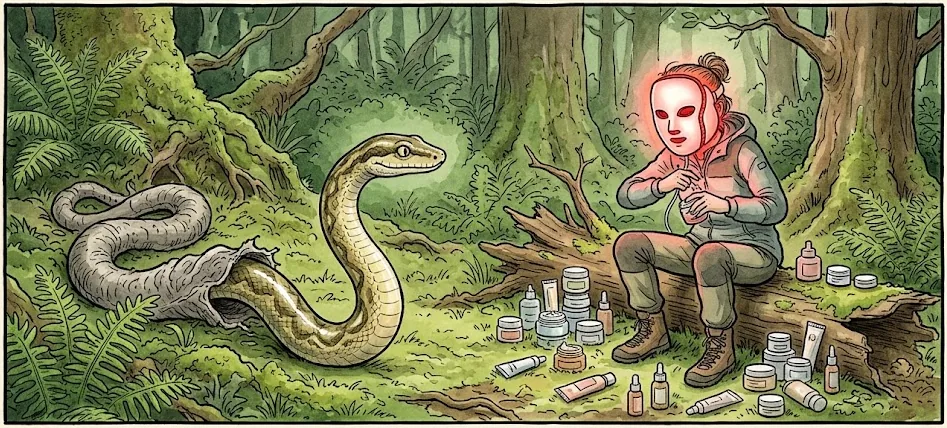
We are surrounded by small, ruinously expensive, mirror-polished jars filled with synthetically produced snail slime, hyaluronic acid and firming peptides. We are caught up in a convulsive, capitalised hunt to freeze biological time at precisely the second we turned twenty-seven.
We live in a culture that suffers from a massive, collective and deeply disabling fear of decay. A culture in which, paradoxically, we try to cheat and conquer nature by buying its most expensive, lab-made and patented secretions and then smearing them on our own faces every blessed evening, while we count the new lines on our foreheads with a quiet, creeping panic.
The anti-ageing industry is not merely a sector; it is a global empire that lives fat, undisturbed and exceedingly cynically off our imagined inadequacy. The market has seen through a fundamental, incontestable truth about modern man: we now live considerably longer, and we are expected to be vital, productive and, not least, sexually active well into our biological autumn.
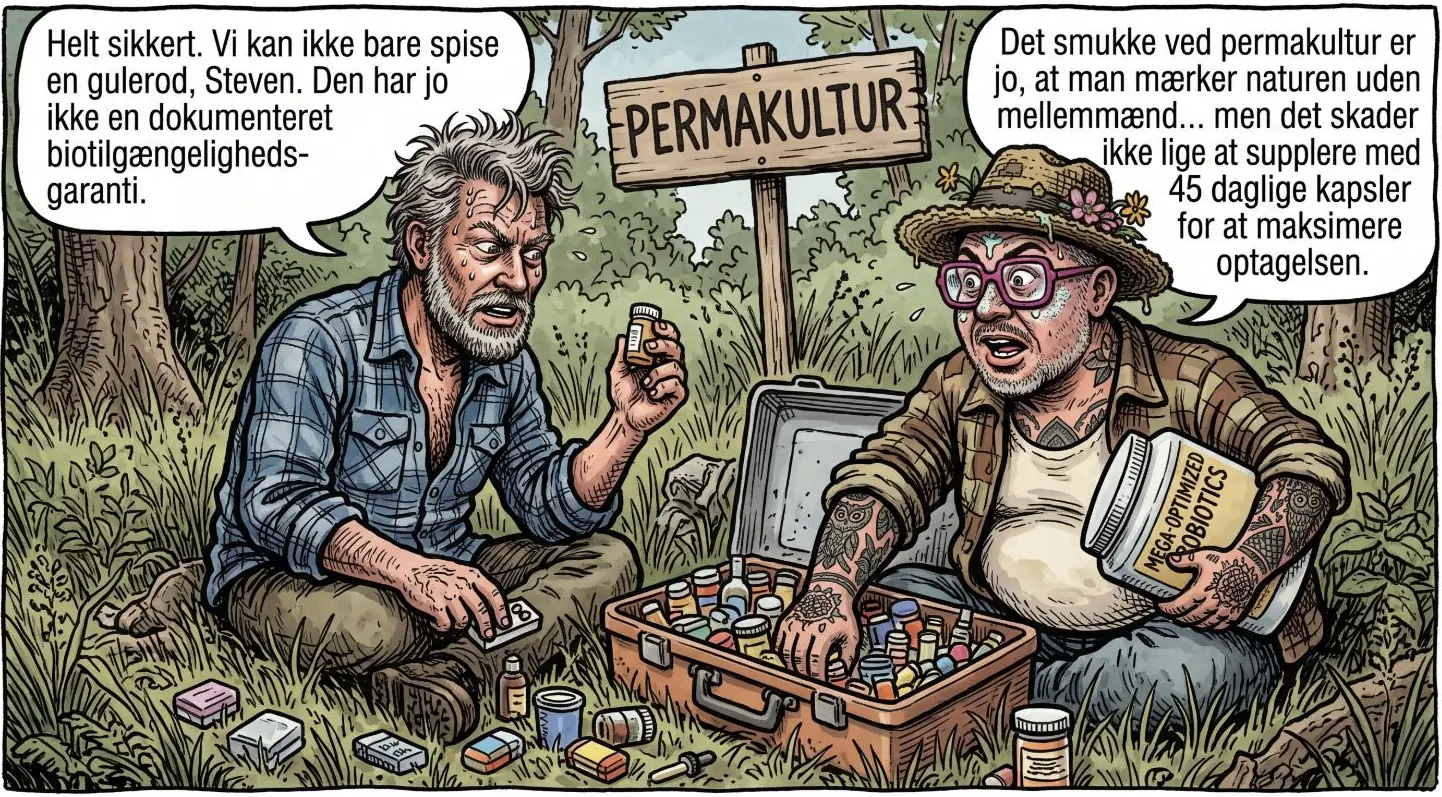
This extended lifespan has given the cosmetic and pharmaceutical industries an entirely free hand to convince us that our bodily, social and intimate worth is bound up solely with a smooth, taut and utterly wrinkle-free surface. As the acclaimed French-Israeli sociologist Eva Illouz has so aptly described it in her searching analyses of modern love and capitalism, our bodies have been reduced to what she calls 'sexual capital'1.
Sexual capital is a merciless, exhausting currency that, in modern society, we must constantly invest in, maintain and defend tooth and nail against the relentless inflation of gravity and time. In this high-voltage body market, youth is the hardest currency there is. Youth sells because we are biologically and culturally coded both to celebrate it aesthetically and to fear its loss existentially.
We want it, we want to control it, we want to see ourselves reflected in it, and above all we want to consume it and have sex with it. It is an ancient, evolutionary dance that has gone on since the dawn of humanity, but in the age of late capitalism the dance has been ruthlessly systematised, fitted with an unreasonably high price tag and then sold back to us as an endless series of subscriptions at expensive beauty clinics and gyms, and in online shops without end.
This vast obsession with perfect, flawless and eternal youth does not, however, arise in a vacuum. It is fed daily and intensely by a public, digital space that has become ever more thoroughly pornified and saturated with a polished, superficial and hyper-visual sexualisation. From morning to night we are bombarded with tens of thousands of images of bodies that are not merely young but digitally cleansed of every trace of human fallibility.
A while ago I came across the South Korean, Germany-based philosopher Byung-Chul Han.
As he points out with precision in his thought-provoking essay on the crisis of beauty, it is 'the aesthetics of the smooth' that dominates our zeitgeist and our deepest consciousness2.
Everything in our age – from the cold, sleek surface of our expensive smartphones to the texture of the skin on our biological bodies – must be completely clean-shaven, frictionless, poreless and filter-optimised. There must be no resistance. There must be nothing that snags, bulges, sags or tells an imperfect, human story.
But in this constant, clamorous and deeply exhausting exposure to the visually flawless, we slowly but surely lose our eye for what is genuinely erotic. We simply mistake the sterile, pornographic objectification of a taut body for real, nourishing, life-giving sensuality. We let ourselves be persuaded that looking "fuckable" in a screenshot is the same as being a deeply lovable, sensual creature.
When the ideal of beauty is made so narrow, algorithmic and uniform that only a very few bodies, the genetically blessed or the massively surgically and dermatologically optimised, can live up to it at all, we put ourselves in a deeply tragic, collective predicament.
We create a society in which only a vanishingly small, privileged elite can even hope to be "correctly" objectified by the market’s exacting standards, while the rest of the population is left in a permanent state of blind, eternal vanity and chronic self-loathing. We persuade ourselves that we can buy beauty and allure through the next expensive cosmetic fix, the next paralysing injection or the next purging, punishing juice cleanse.
But in reality we are merely buying ourselves deeper and deeper into a performative straitjacket that slowly, drop by drop, smothers our real joy in life. We simply forget that true eroticism, true magnetic attraction and true bodily intimacy have never once been a visual, static performance put on display on a screen. It is a vulnerable, bodily, dynamic and deeply relational exchange between two living, fallible, breathing human beings who dare to let their guard down.
In this market-made panic, as we run about lost and breathless in search of the newest, dearest cure for our own natural biology, we forget everything that money, status and products will never come anywhere near being able to buy us.
We simply lose touch with the substance of real life.
We forget raw, unfiltered, unpolished sensuality.
We forget the effortless, playful, life-affirming flirtation that arises in a sudden flash of intense eye contact across a table.
We forget the deep, warm, bodily and emotional contact that has nothing whatsoever to do with the transactional, superficial value of our outer shell on a digital attention market.
The market whispers constantly and insistently in our ear that we are unwanted from the day our skin inevitably loses its elasticity, and that our licence to exist as sexual, interesting and attractive beings expires in step with our youth.
As a tragic consequence, we lose all sight of the worth of the deep, beautiful wrinkle beside the eye, which is there only because we have laughed to our hearts’ content and squinted into the sun for decades.
We try by every means to erase and plaster over the fold in the skin that ought really to be worn as a badge of honour; a bodily testimony that tells a rich, complex and wonderful story of a long life lived, of crises survived, of grief, joy, adversity and priceless experience.
In short, we forget how to age with an upright, natural and insistent dignity. Instead of wearing our advancing years as a well-earned crown of experience and insight, we submit, entirely of our own free will, to a regime in which the body’s perfectly natural, biological change is regarded as a personal, moral failure.
We learn to see a grey hair, an age spot or a slack muscle as direct proof of a lack of personal discipline, of laziness or of insufficient purchasing power, in a society where one is expected to buy one’s way out of the very course of nature.
If you want to understand exactly how deep this fear of decay, this dread of the body and this extreme obsession with youth really run in us as a culture, you need only cast an honest, unvarnished look at our relationship with the older generations.
The way we treat our old exposes our own collective neuroses with brutal and painful clarity. Look at societies such as South Korea, Japan or the many southern European and Latin American cultures, and we see societies where it still comes quite naturally, respectfully and effortlessly to honour the old. There, the elderly are given respect and a place at the table "just because". They are a fully integrated part of daily, public life as respected bearers of the long wisdom of family and society, and the generations mix constantly, vividly and effortlessly in the small and large spaces of everyday life, in the town squares, on the streets and in the homes.
In Denmark and in much of the performance-driven modern West, by contrast, we have developed a bizarre, clinical and deeply unnatural habit of deliberately hiding old age from the street. We pack the elderly away in well-run but usually utterly isolated institutions and care homes, where they can keep themselves to themselves in peace without disturbing or delaying our busy, streamlined, optimised daily lives.
We see them primarily, almost exclusively, at dutiful, scheduled 'soup, roast and ice cream' occasions – the fixed milestone birthdays, the confirmations and the annual Christmas – where the various age groups sit neatly, orderly and harmlessly divided at the tables. We simply push the older generation, and everything it represents, out to the very outermost periphery of our daily awareness and our pulsing urban spaces.
But we probably do not do it out of malice or a lack of empathy; we do it first and foremost because their wrinkled faces, their slower, careful movements and their decaying, honest bodies act as merciless, unforgiving mirrors held up directly in front of us. They efficiently strip away all our illusions of immortality.
They stubbornly remind us of the inexorable biological fate we ourselves are hurrying towards – the very fate we spend all our hard-earned fortunes, our expensive face creams and the whole of our flickering mental health running from, screaming, into the dark. To look at the older, unpolished body is to look straight at one’s own inevitable future defeat in the demanding eyes of the market, and that fear we flatly refuse to face.
But the great truth – the deep, somatic, liberating and unshakeable truth that we have sweated clean out of ourselves in our harried chase after status – is that the body’s slow decay is not a bug in the system. It is not a tiresome illness to be cured like a pathology, and it is not a design problem that can suddenly be solved by a new, well-funded start-up product from a glass cube in Silicon Valley.
It is a fundamental, indisputable biological fact which – if we dare to look at it with open eyes – carries its own inevitable and magnificent beauty. Just as the great old oak in the field lets go of its withered leaves in autumn to conserve energy, without putting up any convulsive, pointless resistance to the falling temperature, there is an enormous somatic and spiritual liberation in daring to let go of youth’s tight, suffocating corset of expectation.
Coming home to the body does not only mean celebrating and feeling it in the few decades when it is young, flawless, strong and supple; it means, at least as much, feeling, respecting, accepting and loving it wholeheartedly when it inevitably grows softer, weaker, wrinkled and infinitely wiser.
When we finally dare to tear the absurd, glowing LED mask off our faces, switch off the phone’s mendacious filter apps for good and stop measuring our own existential and human worth by the absence of pigmentation flaws and gravity, something almost magical happens. When we step consciously, calmly and provocatively out of the instrumentalising, greedy market that tries only to cash in on our deepest insecurity, a space suddenly opens for a far deeper, more grounded and genuine peace.
A peace in which the body is no longer regarded as an endless, exhausting and expensive perpetual project that must constantly and without pause be fixed, hacked, starved, trained and polished merely to be marginally "good enough" in the eyes of others. Instead, the hard-tried body may at last be allowed to be exactly what it was originally made to be: a safe, lived-in home. An organic, breathing organism that bears its scars, its inevitable physical changes and its long, beautiful, motley history with absolute pride, calm and integrity.
To accept bodily decay is, in its purest form, to take back power over one’s own life. It is to refuse, stubbornly, to let one’s self-worth and one’s capacity for pleasure be dictated by an unscrupulous industry that survives, and earns billions, only for as long as you go on hating your own unfiltered reflection.
We are in crying need of rediscovering a deep, grounded and honest respect for all the different phases of lived human life, and of ceasing collectively to fetishise the one short decade of existence in which the skin happens to be tightest over the cheekbones. We need to look at the ageing, marked body and see life lived, impressive survival, laughter, tears and deep wisdom, rather than merely – through the market’s narrowed lenses – a defective body that has, alas, lost the endless competition of optimisation.
What would actually happen to our superficial relationships, our harried, performance-driven sexuality, our deep inner well-being and our collective social calm if, from tomorrow, when the sun rose again, we finally decided to surrender, let gravity win its natural victory, and instead began, sincerely and wholeheartedly, to celebrate the bodies that actually look as though they have had the courage to live a whole and genuine life?
That is precisely why Lai and I have decided to devote the rest of our lives to building bridges between the generations. Because we want an old age surrounded by life, by vitality, one that takes its inspiration from both the new and the old. That dances to life’s last drop. A community that celebrates people at all their natural ages, and where growing old is only part of the adventure of being born on this fantastically beautiful earth.
Sources
1. Illouz, E. (2012). Why Love Hurts: A Sociological Explanation. Polity Press.
2. Han, B.-C. (2018). Saving Beauty. Polity Press. Translated by Daniel Steuer from Die Errettung des Schönen (S. Fischer, 2015).