The body as performance, part 5 of 6 · 7 min
Sleep as performance
By Steven Wensley, MA in history, and poet.
You open your eyes. The room is dark, the duvet is warm, and you actually feel strangely well rested. But before you have so much as considered putting your feet on the floor, your arm reaches for the bedside table by pure reflex. You grab your phone, are dazzled by the blue light of the screen and open your sleep app, so that an algorithm can tell you how you actually feel. The screen glows an ominous yellow: Readiness Score: 41%. You got only 12 minutes of restorative deep sleep.
In a split second the immediate sense of being rested evaporates. The app has spoken. You are officially exhausted. You drag yourself to the bathroom, peel the kinesiology tape off your lips, take off your orange blue-light-blocking glasses and brace yourself for another day in survival mode, all the while mentally planning how to micro-dose magnesium and optimise your 'sleep space' for tonight.
We have managed to turn something as basic, animal and uncomplicated as falling asleep into a gruelling, data-driven competitive sport. We no longer sleep in order to rest; we sleep to set a new high score.

Sleep, for a long time, was the last protected refuge. It was the third of our lives that the capitalist system could not reach, because we were literally lying unconscious, incapable of producing, consuming or networking. But the market abhors a vacuum. So instead of leaving sleep as a free space, we have instrumentalised it. Sleep has been rebranded as 'recovery' – a necessary pit stop whose sole purpose is to make us more efficient, sharper and more profitable machines when we are awake. Your Oura ring and your smartwatch are not your friends; they are the inner, digital middle manager who checks whether you really are preparing optimally for tomorrow’s KPI hunt. We have gamified our own biology, and the winner is whoever can display the most perfect, unbroken graph on the screen next morning.
The tyranny of the eight-to-four society (and the Scandinavian winter dark)
Much of this frantic sleep optimisation springs from a fundamental, almost comic mismatch between our animal bodies and the structures of the modern labour market. We have built a society around an unbending eight-to-four rhythm that assumes a human being is a simple solar panel with a constant, unchanging battery, which need only be charged for eight hours in order to deliver the same output every blessed day, whatever the season, age or circumstances.
Here in the Nordic countries in particular, the absurdity is on full display once the calendar reaches November. The dark settles over Scandinavia like a wet, heavy woollen blanket. It is pitch black when the alarm goes off at six, and pitch black again when we clock out of the office at four. Our cells, our hormones and our evolutionary clock are screaming for one thing only: Hibernate. Our biology is asking us to turn down the flame, retreat to the cave and conserve energy, exactly like the bear in the forest.
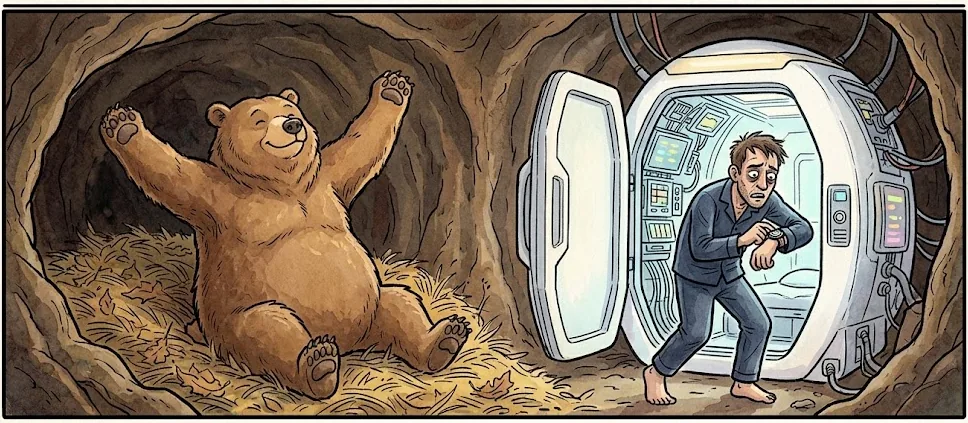
And how does society respond? With quarterly accounts, Christmas dos, strategy seminars and the expectation that we deliver peak performance at precisely the moment nature asks the opposite of us. Instead of accepting that nature has given us a greater need for rest and quiet in the winter half of the year, we try to force ourselves into summer’s productivity template with light-therapy lamps, 14 cups of coffee and desperate attempts to biohack our circadian rhythm. We are waging a stubborn and doomed war against the tilt of the Earth and our own DNA, solely because the machinery does not allow for seasonal variation.
The illusion of a constant need for sleep
The whole sleep-tracker industry rests on another harmful illusion: that our need for sleep is a mathematical constant, and that the quality of our nights can be isolated from the quality of our days. We treat sleep as an isolated mechanical problem. If we just buy the right weighted blanket, set the smart bedroom thermostat to exactly 18.5 degrees and listen to pink noise on Spotify, we will surely sleep the required seven and a half hours and hit our REM cycles perfectly.
But we forget that sleep is the most sensitive mirror of the life we live. Your need for sleep is not constant. If you are in the middle of deep grief, an existential crisis or simply an exceptionally demanding period, you may need ten hours – not to perform, but to heal. Conversely, if you are newly in love, deeply absorbed in a meaningful project or bathed in summer sun, your body may thrive splendidly on six.
We tend to treat the symptoms of our insomnia with gadgets, because that is easier than looking at the cause. If you lie awake night after night staring at the ceiling while your heart hammers away, it is rarely because your bedroom is too warm or because you forgot to drink your camomile tea. More often it is because your working life is toxic, because your relationship is ailing, or because you are living a life so drained of real meaning that your subconscious refuses to let you rest. You cannot optimise your way out of depression or burnout with a smartwatch. Quality of life and quality of sleep are two sides of the same coin, and as long as we ignore why we cannot sleep, biohacking is merely a sophisticated plaster on an open wound in the body.
How to lay down your arms and find calm again
Coming home to the somatic – feeling your body and letting it dictate its own needs – requires an active, almost rebellious rejection of the culture of optimisation. It is not about adding more routines to your evening but about taking something away. Here are a few ways to disarm performance sleep and rediscover an uncomplicated calm:
Fire your digital middle manager: Take the watch off when you go to bed. Delete the sleep app. Let go of the need for external, technological validation of your own bodily state. Allow yourself to notice how you feel. If you wake up feeling sharp, you are sharp – whatever a server in California thinks of the matter. Wake up, stretch, and feel for yourself in your own muscles and joints.
Abolish the bedroom as workplace: The bedroom has become an extension of the office. It is where we check the last emails, scroll through other people’s successful lives on LinkedIn and prepare tomorrow’s worries on a screen. Throw the phone out of the bedroom. Buy an analogue, dumb alarm clock. Make the room a technology-free zone to which performance, likes and news feeds have no access. Let it be the one room in your life that is entirely uncoupled from the market.
Embrace the wakeful night: One of the biggest causes of insomnia is anxiety about insomnia. We lie there working out how shattered we will be tomorrow if we do not fall asleep within eight minutes, because we have to perform. But historically, people often slept in two shifts with a waking period in between. If you wake at three, drop the panic. Accept that you are awake. Read a book, look out into the dark, let your thoughts wander freely, without fear of tomorrow’s Excel sheet. When we take the demand for performance out of sleep, it often comes of its own accord.
Bow to the seasons: Instead of fighting the winter dark with artificial daylight and caffeine, try surrendering to it. Lower your expectations of yourself in November and January. Accept that you may be a little slower, a little more tired, and in need of an earlier night. That is not a fault in your system; it is your system working exactly as it was designed to over hundreds of thousands of years of evolution.
In the end, it is about letting the body be a body again. It is about realising that rest is not a tool we use so that we can work harder, but a fundamental, inviolable right we have simply because we breathe. The real revolution does not start with a new app or an expensive physiological hack. It starts the evening you get under the duvet, turn off the light and decide that you owe no one – not your boss, not society, not your watch – proof of how well you rest.
Do you think, dear reader, that we as a society will ever be able to accept the dark and the turning of the seasons again, or are we permanently locked into the belief that we can light, measure and optimise our way out of our own biology?