Friction, part 3 of 3 · 8 min
Unmasked, and the difficult art of caring for each other
By Steven & Lai
Money's most seductive promise is not wealth. It is independence. Our entire modern existence is built around the story that if we only work hard enough, save enough, earn enough and insure ourselves properly, we need never be a burden to anyone. We can buy ourselves a home, we can pay for our food, we can subscribe to entertainment, and we can hire experts to fix everything from our dripping pipes to our broken hearts. The ultimate dream in a late-capitalist society is to be completely freed from the need for other people's mercy. Money is the lubricant that lets us rub up against thousands of strangers in the city without ever hurting ourselves on them.
But in this total liberation we lose the fundamental thing: we lose the ability to reach each other. For real love and unfiltered community require that we need each other. They require dependence.
When we on Agersø work to remove money from the equation and remove the transactional straitjacket, we quickly discover that money works as a social mask. It lets us hide our fragility, our vulnerability and our shortcomings behind a credit card. Putting the money down is a radical dropping of the mask. It leaves us naked. It tears away the protective membrane that capitalism has stretched between us. And this is where the real and often painful lesson begins. For without money's lubricant, relationships are full of friction.
The illusion of outsourced care
The Danish theologian and philosopher K.E. Løgstrup formulated the core of our human condition in his major work The Ethical Demand: «We never have to do with another person without holding some part of that person's life in our hands.» Løgstrup understood that we are inescapably and fundamentally delivered over to each other. Our mere existence weaves us into our neighbour's fate.
But in our modern, highly efficient welfare society – which at its core is deeply woven into the logic of the market – we have gradually tried to outsource this ethical demand. We pay our taxes and buy our insurance so that professional systems can hold the other person's life in their hands for us. We institutionalise care. We hire educators to look after our children, elder care to look in on our parents, and we pay psychologists and therapists to contain our friends' crises when they become too heavy or too long-lasting for us to carry ourselves over a cup of coffee. The professor of psychology Svend Brinkmann has long warned against precisely this tendency: that we pathologise and professionalise ordinary human suffering because, as a community, we have lost the ability and the surplus to bear it together.
It is systemically efficient, and it protects us from the violent, exhausting friction of having to carry other people's suffering and needs every single day. It makes life smooth. But it also creates an emotional vacuum. When we can buy help and outsource our responsibility for the weak, the hungry and the unhappy, our own hands slowly forget how to carry another human being. We lose the musculature for close, imperfect and troublesome care. We lose the very language that is spoken when you ease another person's pain without being paid for it.
Imperfect mercy
To understand why it is so mercilessly hard to take off the masks and live without money, we can look to the French anthropologist Marcel Mauss and his classic work The Gift from 1925. Mauss studied the gift economies of indigenous societies and found a decisive difference between a transaction and a gift. When you buy a cup of coffee in a capitalist transaction, you pay the money, you get the coffee, and then you are quits. The bond is cut. The transaction is complete, and you owe each other nothing. It is easy, it is convenient, and it requires no future relationship.
But when you live in an economy that is not based on money – like the movement we are trying to let grow – this clean, frictionless ending does not exist. In a gift economy, or a genuinely communist community where each gives according to ability and receives according to need, every exchange creates an invisible bond. If you build my door frame and I share my harvest with you, we are woven into an eternal, unfinished debt of gratitude and obligation. The gift carries part of the giver's soul with it, Mauss said. It is beautiful, but it is also heavy. It requires that you constantly relate to your fellow human beings. You cannot simply pay your way out of smiling at the neighbour. You are forced to preserve the relationship.
It is precisely this constant connectedness that creates friction in a life without money. Capitalism has taught us to hate obligations that cannot be settled in a spreadsheet. We have become afraid of owing each other anything. Living without capital's lubricant means stepping directly into an endless web of mutual dependence, and it requires us to unlearn decades of indoctrination that the successful adult is the isolated, independent adult.
The German sociologist Hartmut Rosa speaks of the concept of resonance. He describes our modern society as being in a state of constant acceleration, in which we try to control and optimise everything to make the world behave. Money is the ultimate instrument of control. With enough money we can dictate exactly what our surroundings should look like and whom we want to interact with. The problem, according to Rosa, is that when we have full control over the world, the world falls silent. We lose resonance – the deep, vibrating feeling of being touched by something outside ourselves.
Resonance can only arise in the uncontrollable. It arises when we open ourselves to the unpredictable, the troublesome and the foreign. It arises when we give up the false independence.
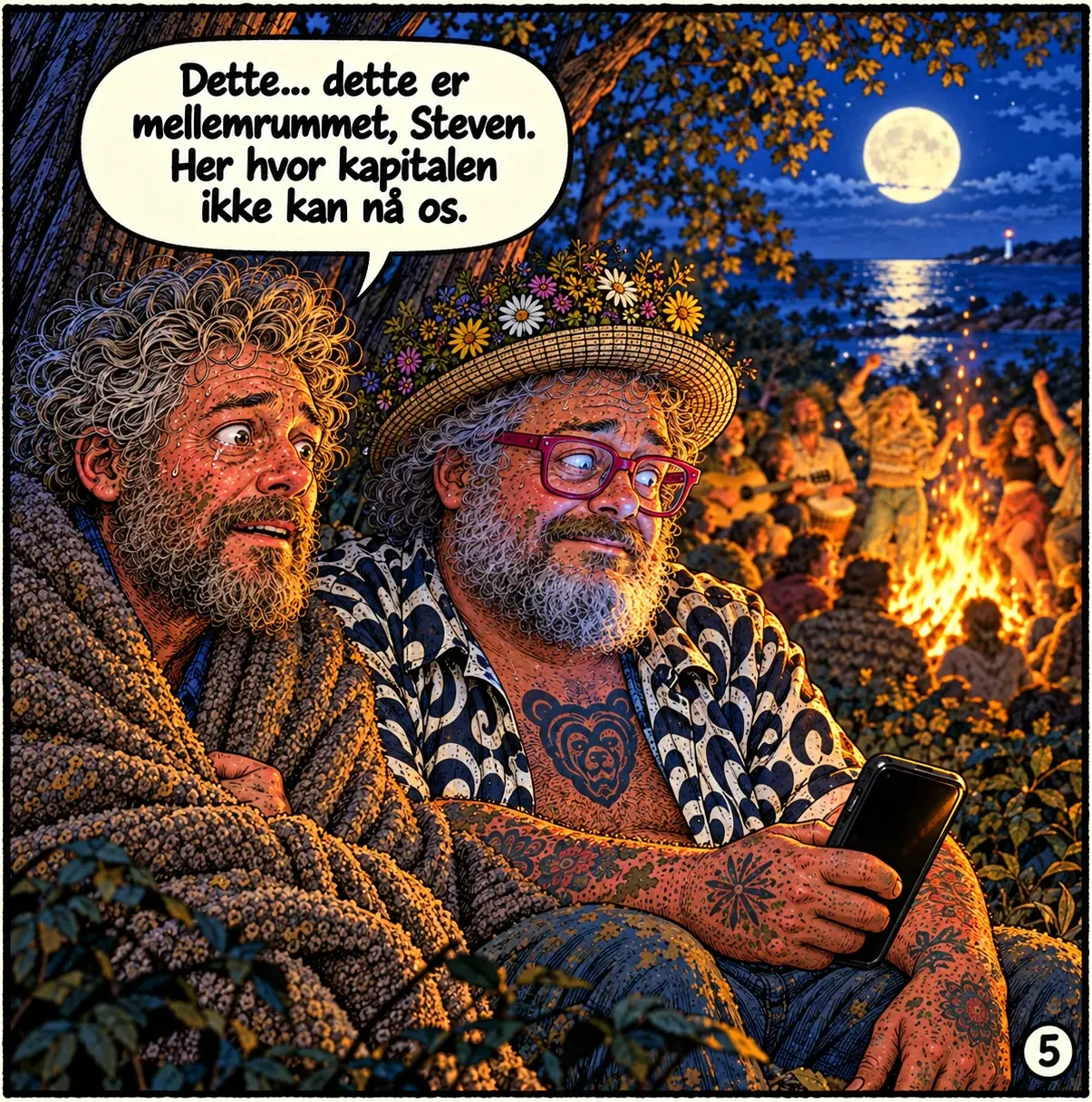
When we on Agersø insist on peeling the financial layer away, it is an attempt to regain this resonance. But we do it with our eyes open, because resonance is exhausting. When the masks fall, there is no buffer between us and the other.
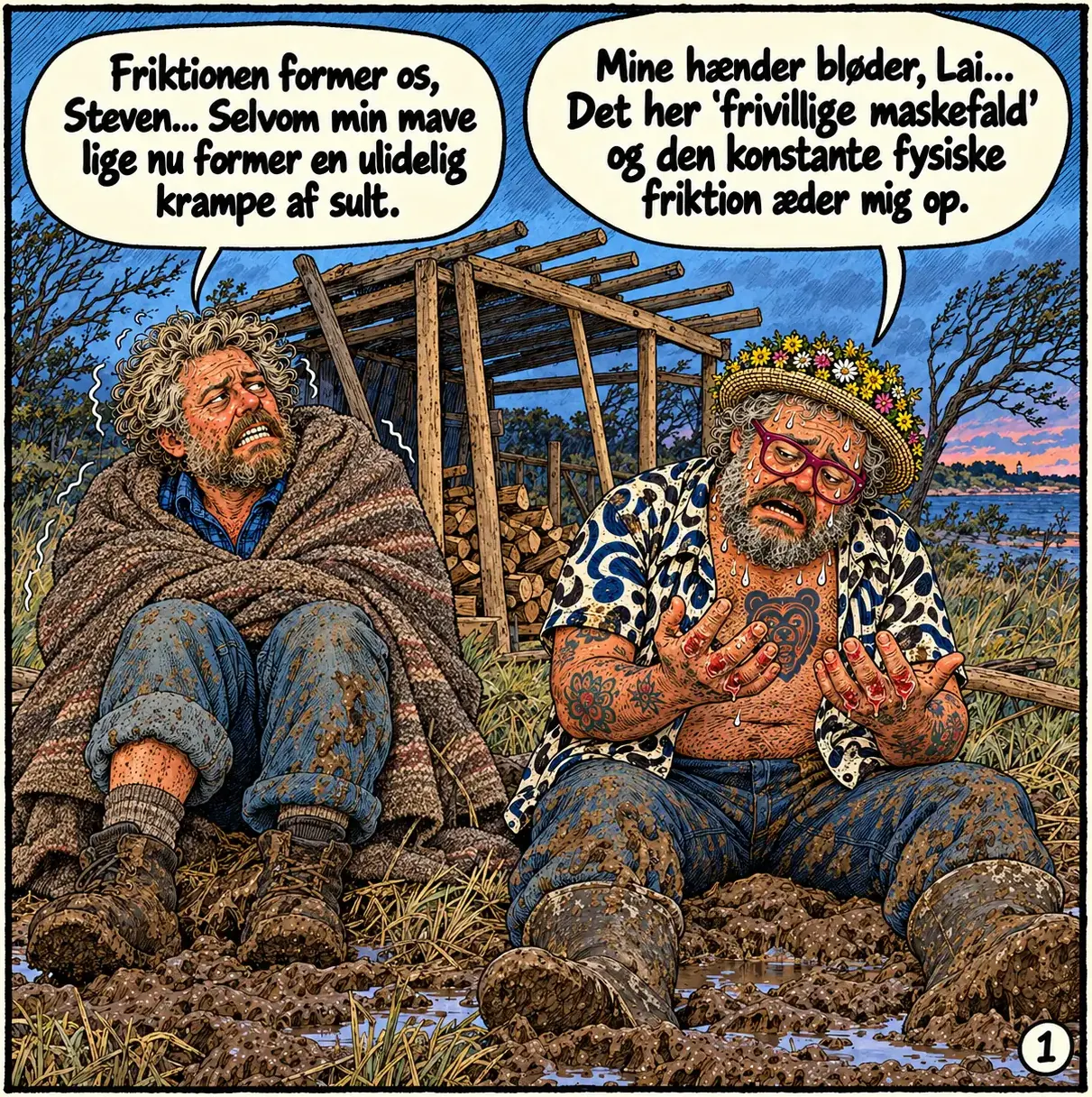
If someone in the community is hungry, we have to share our own food, even when we ourselves are running low. If the roof leaks during a winter storm, we cannot hire a professional firm to patch it while we watch Netflix; we have to go out into the mud ourselves, cold and irritable, and try to find a solution with frozen fingers. If a person in the camp breaks down under the weight of their own demons or dark thoughts, we cannot pull out a card and refer them to a treatment system. We have to sit beside them. We have to listen, even when we ourselves are burnt out, and we have to bear not having a clinical solution. We are forced to embrace an imperfect, messy and extremely time-consuming mercy that demands everything of us.
There is a massive, almost gravitational temptation to wish yourself back to the convenience of the system. To earn some money to remove the pain and the responsibility. To donate a hundred kroner through an app to support the homeless and silence your conscience, instead of physically having to sit down on the asphalt, reach out a hand and smell another human being's decay. To pay climate indulgences for your flight instead of fundamentally changing your life. Money lets us buy absolution without having to change our hearts. It is infinitely harder to carry each other's burdens in practice than to pay a system to do it at a distance.
Life without money is not for the faint-hearted. It is not a romantic forest bath for upper-class citizens who need a break from the spreadsheets. It is a brutal re-education of the modern human being. We swear, we doubt, and now and then we long for the ease that capital can offer.
But slowly, beneath the massive exhaustion, a shift happens. When we are forced to endure the friction, we begin to feel the world again. The threads between us that Marcel Mauss described become visible and strong. We discover that the vulnerability and dependence we spent years trying to insure ourselves out of were in reality the very keyhole into a meaningful life.
We find out that being human is not about optimising your way out of your problems or buying your way free of your obligations. It is about daring to let others hold a part of your life in their hands – and about having the courage to grasp theirs when they hold them out. Money can build walls thick enough that we never need to feel the cold or feel inadequate. But the true path to a life in cosmic balance is not paved with independence. It is paved with the beautiful, chaotic and troublesome art of daring to need each other.