Friction, part 1 of 3 · 6 min
The convenient poison: Why we need the friction that money removed
By Steven & Lai
Money is the ultimate lubricant. In modern, late-capitalist society, capital serves a very specific and seductive purpose: it removes friction. Hungry? A beep on the phone, and the food arrives at your door. Cold? An automatic transfer to the electricity company takes care of the heat. Need care, therapy or someone to look after your children? You buy a professional service and sign a contract. We have slowly been lulled into a safe, polished illusion that life is easy – provided, mind you, that there is money in the account.
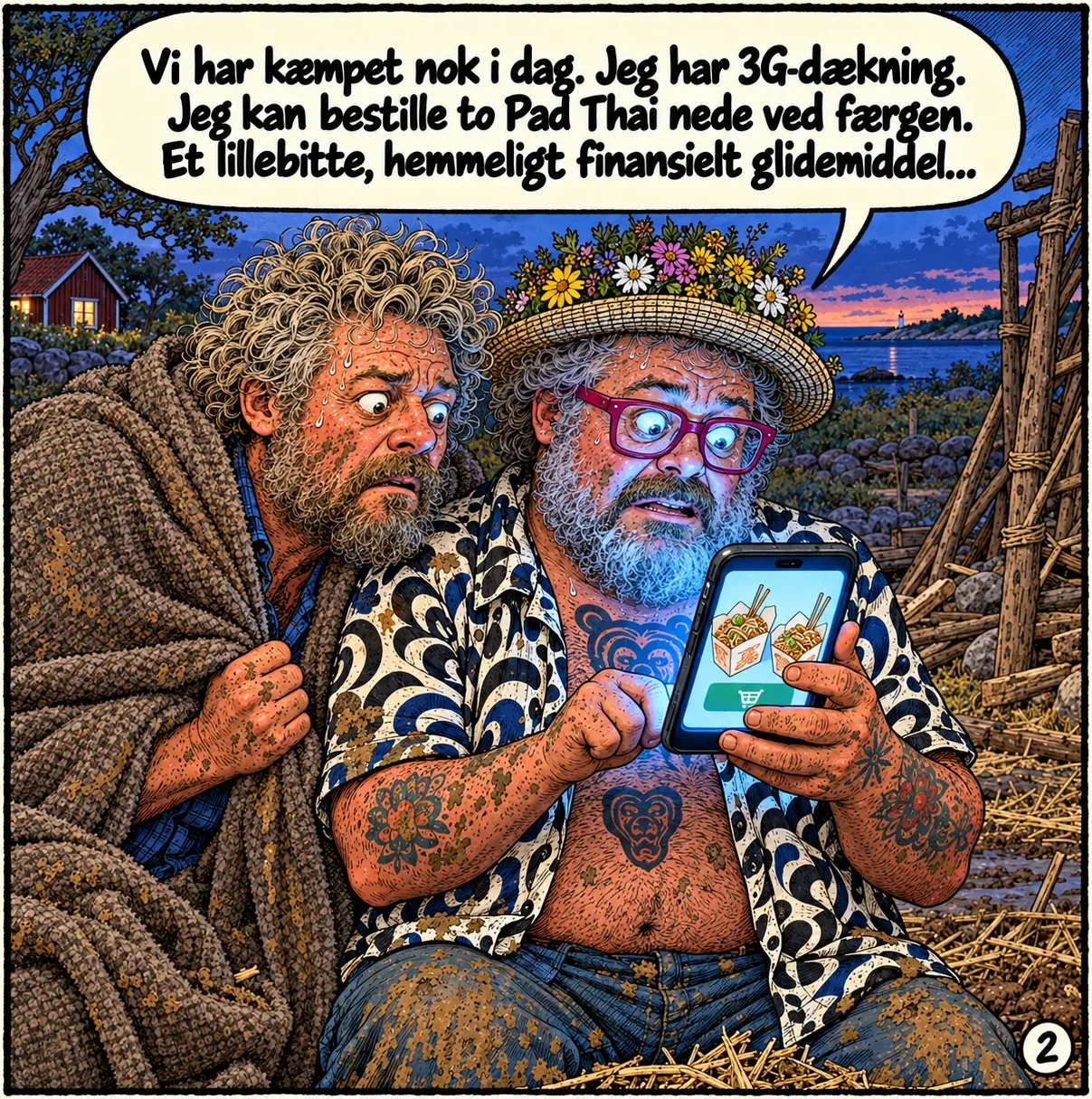
That is the triumph of convenience. But the absence of friction is not the same as the presence of meaning.
When we in the Vendhjem movement, and quite concretely in our work on Agersø, try to live without – or with an absolute minimum of – money, it is a radical break with this lubricant. And let us make one thing clear straight away, so we don't descend into sectarian pocket philosophy: it is in no way easy to live without money in a society designed around it. On the contrary. Without money, life in a capitalist system is brutal. It is cumbersome, it is demanding, and it forces us to look each other in the eye, for better and for worse.
But it is precisely in this cumbersome friction that we can truly rediscover our character and our real humanity.
From the 3D cinema to raw theatre
The professor of psychology Svend Brinkmann and several contemporary thinkers have long pointed out that our constant pursuit of convenience, optimisation and the shedding of responsibility threatens to hollow out the deeper meaning of existence. When all resistance disappears, so does the friction that shapes us as human beings. Money lets us glide frictionlessly across the surface of life. It allows us to consume the world without engaging with it, and it allows us to interact with other people without ever making ourselves genuinely vulnerable.
Opting out of this financial lubricant is a violent paradigm shift. It is best described as going from watching a hypermodern 3D film in a cinema to attending a raw piece of theatre.
In the 3D cinema the experience is overstimulating, smooth and designed to seduce you. But you are fundamentally passive. You sit behind your plastic glasses in the dark and consume a reality that others have produced and wrapped up for you. The distance between you as subject and the film as object is total, even though the technology does everything to hide it.
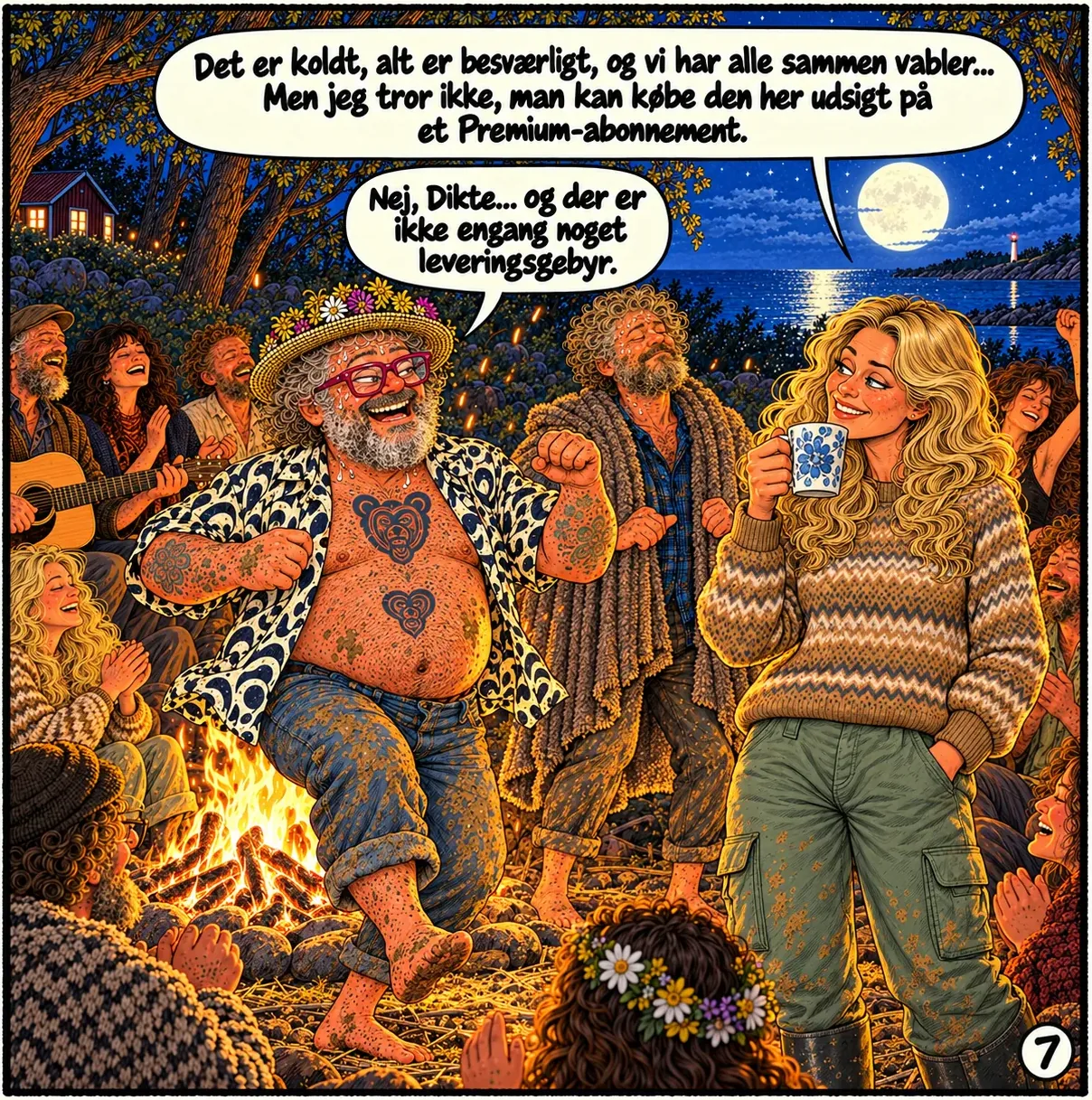
When you step into a theatre – just as when you step into a community based on barter, trust and direct relationships – that distance falls away. In the theatre you can hear the floorboards creak. You can see the sweat on the actors' foreheads. You feel the dust in the air. It is imperfect, it demands your active presence, and it erases the distance between you and what is going on.
Real life without money requires massive adjustment, precisely because we suddenly stand on the stage together. We can no longer simply pay our way out of a conflict, buy help for a building project or swipe our way to a meal. We have to negotiate, we have to ask for help, and we have to risk a no. We have to endure the friction. To claim that a money-free way of life is merely an uncomplicated, romantic dance with nature would do our own movement irreparable harm. It requires rock-hard adjustment. But friction breeds character.
Two sides of the same addiction: Energy and capital
To grasp the depth of this challenge, we have to zoom out and look at the crises we face collectively. I am responsible for the IT infrastructure at Klimabevægelsen.dk, and I see our two movements as deeply connected partners. Fundamentally, we are fighting the same fight.
The climate movement is fighting a dogged and necessary battle against humanity's deep, destructive dependence on fossil fuels and our overconsumption of energy. In Vendhjem we fight dependence on capital. The mechanism behind them is strikingly similar. As humans we are frighteningly easy to lure into an addiction, especially when the reward is seductive, frictionless convenience.
Our collective addiction to energy has enabled us to manipulate the physical world without physical effort. We clear forests, pump up gas and heat the planet – all to avoid freezing, to avoid waiting, and to escape physical resistance. Our addiction to money works in exactly the same way in the social world. Money allows us to manipulate and navigate the social landscape without making any real social or emotional effort. Money is a shortcut around our obligation to our fellow human beings.
Wrenching ourselves free of fossil energy and wrenching ourselves free of the money system require the same kind of radical, collective withdrawal. Both the climate and the human soul pay the price for our boundless pursuit of making everything easy. Living sustainably – climatically as well as humanly – requires that we accept, in future, a life with more resistance, slower processes and fewer shortcuts.
The stress of poverty and the voluntary dropping of masks
But we must dare to do the hard thing with our eyes open. We are not a sect blindly preaching a gospel without acknowledging the gravity of reality. And the reality in Denmark today is that a lack of money hurts.
Danish research and countless reports from organisations such as the Economic Council of the Labour Movement clearly document that poverty in a capitalist society is directly linked to massive stress, social marginalisation and illness. When you are involuntarily deprived of money in a system where money is the only ticket to survival, dignity and participation, you break down. That is a brutal reality. The absence of money is not holy in itself; as a systemic failure it can be deeply traumatising.
The difference between involuntary poverty and the project we are building on Agersø is the infrastructure of community and the conscious choice. We are trying to stretch out a safety net woven not of cash but of relationships.
And this is where the masks fall. For when we remove money, we also remove the possibility of outsourcing our care. In the established system we pay our taxes and expect «the system» to look after the weak, the vulnerable and the hungry. Without money we are forced to carry each other's burdens with our own bare hands. We are forced to hold the neighbour's vulnerability, listen to the other person's crisis and share from our own limited resources when winter bites or the rain falls.
Living genuinely, taking off the polished masks and actually looking after each other, is not «easy». It is exhausting to deal directly with other people without money's protective buffer. Resolving conflicts instead of simply buying your way out of them gives you blisters on your hands and bruises on your mind.
Is it harder to live like this? Unconditionally yes. But it is also infinitely more meaningful. When we remove the convenient poison that lulls us to sleep, we wake up to a reality that is raw and deeply connected. We wake up to the theatre. It takes practice to stand on the stage, but once we are there, we discover that it is not merely an ideological protest. It is the true and most natural condition of being human.